Give the clue a job in the story
A visual clue is a detail whose meaning changes as the story unfolds. A damp footprint beneath a locked window might first look like background texture, then become important when a character insists nobody entered the room. The clue does not need to support a mystery plot. It might reveal a character’s habit, foreshadow a choice, or help readers understand a scene before the people in it do.
Before drawing, write down what the clue shows and what readers should understand when it pays off. These are different questions. A torn envelope may be visible from the start, while its significance depends on a later conversation about an unopened letter. If you cannot describe the connection in a sentence, the detail may be too vague to carry the intended meaning. If the connection is obvious on first sight, consider giving the clue a less prominent first appearance.
Make its first appearance feel at home
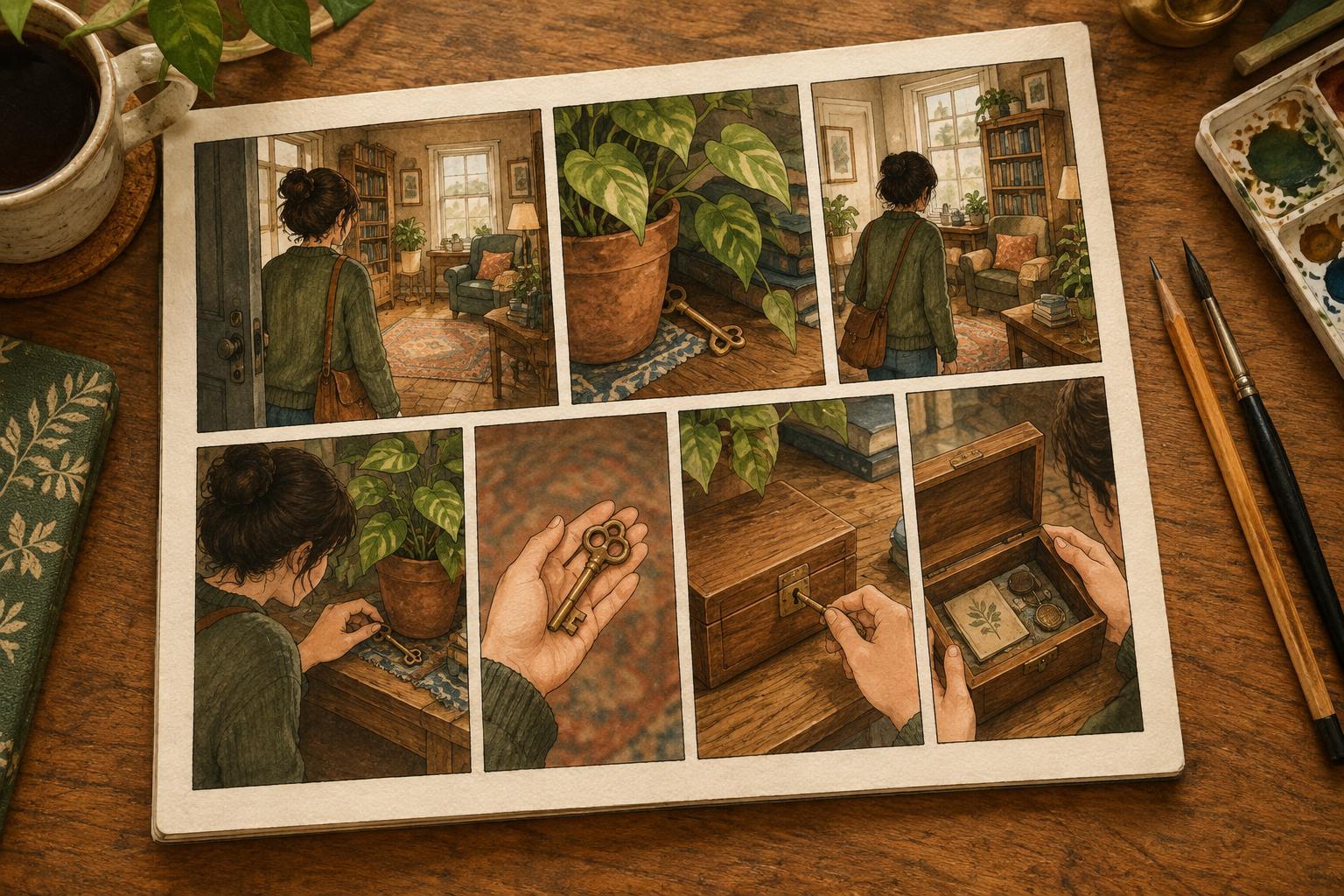
A clue works best when it belongs to the place and action around it. Rather than pausing the scene for a close-up of a misplaced key, let the key sit among the objects a character handles while searching for something else. The reader has a fair chance to see it, but the scene still has a reason to exist beyond delivering information.
Think about what draws the eye through the panel. Faces, hands, strong contrasts, and speech balloons often receive attention first. Place an important clue near that path if readers need to register it. Put it farther from the main action if you want recognition to arrive later. Subtlety should not depend on making an object impossible to identify; its shape and position still need to be clear when a reader looks back.
Track what the reader and the characters know
Clues create different effects depending on who notices them. If readers see a loose stair tread while a character races upstairs, the detail can create anticipation. If both reader and character miss it until someone examines the stairs later, the reveal can prompt a second look at the earlier panel. Neither approach is automatically better. Choose the one that serves the scene’s emotion.
Keep a simple clue list beside the script or thumbnails: first appearance, who can see it, when it matters, and what changes after it is understood. This is especially useful when a story moves between locations or viewpoints. A character should not act on information they never encountered, and readers should not have to remember a detail that appeared only as an indistinct mark several pages earlier.
Make the payoff depend on the planted detail
At the payoff, return to the clue in a way that adds meaning rather than merely announcing that it existed. A character might recognize the mark on an object, use its position to reconstruct an action, or realize that an earlier assumption was wrong. The later scene should point back to something readers could reasonably have seen, even if many did not understand it at the time.
Resist explaining every step in dialogue. Often a repeated object, a changed expression, and one brief line are enough to connect the two moments. If the meaning still feels unclear, the problem may be in the setup rather than the explanation. Try strengthening the clue’s silhouette, showing it in a more informative context, or giving readers another brief glimpse before the payoff.
Test the clue at reading size
A clue that is clear in a large drawing may disappear when the page is viewed at its intended size. Check a reduced version of your thumbnails or finished page. Can you distinguish the clue from nearby shapes? Does its location remain consistent across panels? Can you identify it again at the payoff without relying on a caption? These checks matter whether the comic is read on paper or on a screen.
For a short practice exercise, sketch a three-panel scene around one ordinary object. In the first panel, include it as part of the setting. In the second, let a character make a decision without noticing it. In the third, reveal why the object matters. Then cover the final panel and ask whether the first two panels still feel like a natural scene. A good clue rewards attention without requiring readers to stop and inspect every corner.