Define what finished needs to mean
It is easy to keep working on an illustration when the goal is simply to make it better. There will nearly always be another edge to clean, color to adjust or texture to add. A more useful question is whether the image does the job you made it to do. Before a long drawing session, write a short description of that job: a character should look uneasy, a scene should feel welcoming, or a sequence should make an action easy to follow.
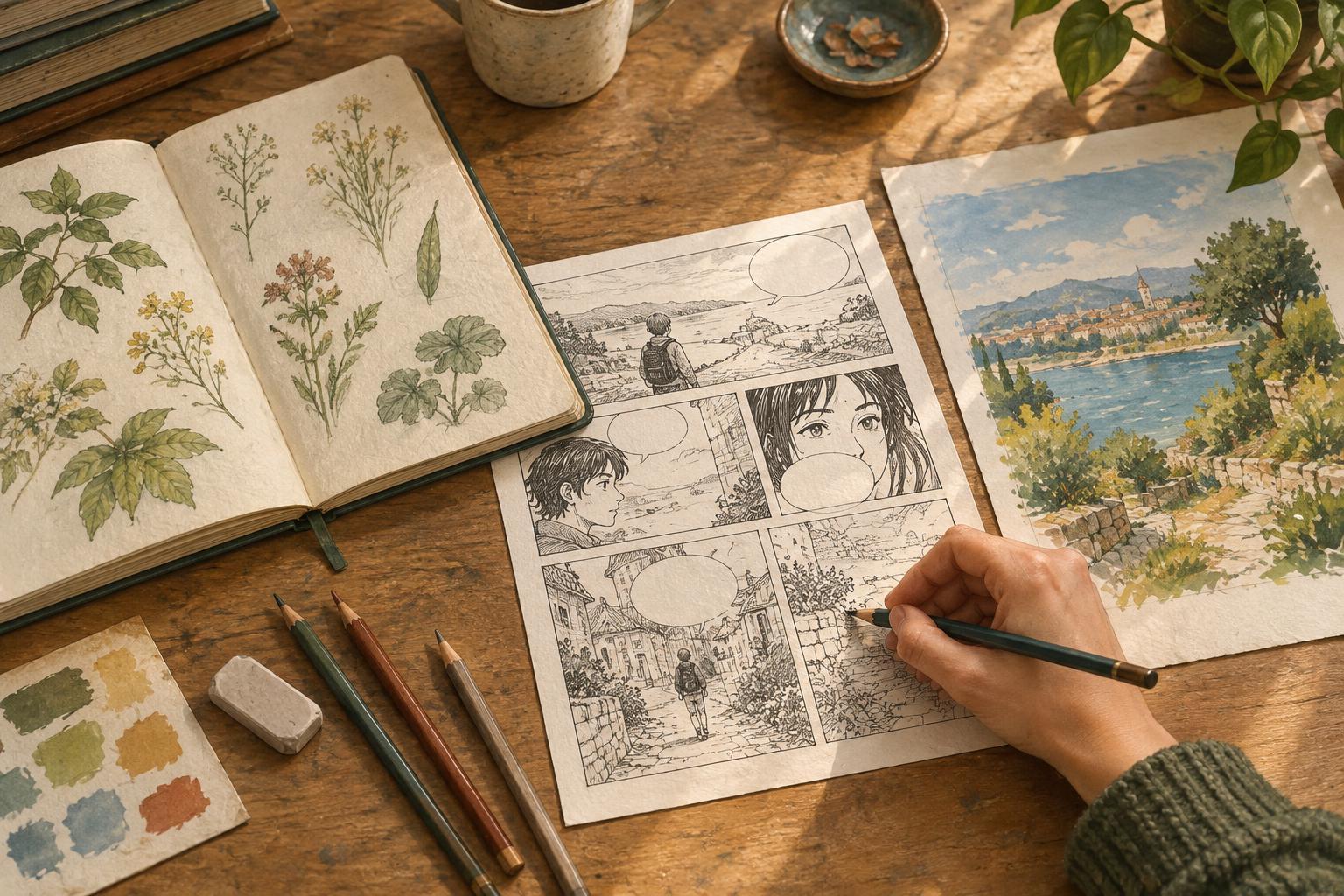
Then identify the conditions the finished piece must meet. These might include a particular size, a clear focal point, readable text or enough empty space for a caption. Keep this list brief. It gives you a way to separate necessary revisions from appealing extras. A small spot illustration may be complete with a strong silhouette and limited detail; a complex comics panel may need more work if the reader cannot tell where to look next.
Check the image at the distance where it will be seen
Artists often make their final decisions while zoomed in, where tiny imperfections look enormous. Step back instead. View the illustration at approximately its intended display size, and try a thumbnail view as well. Can you identify the main subject quickly? Is the important action legible? Do the largest shapes and value differences support the mood you intended? If the answer is yes, another hour of small marks may change little for the viewer.
For a more focused check, look separately at composition, color and detail. Squint at the image to see whether light and dark areas compete for attention. Hide or cover secondary elements and notice whether the central idea becomes clearer. If a new detail pulls the eye away from the subject, removing it may be more useful than polishing it. The goal is not to strip every image down; it is to make each visible choice earn its place.
If the illustration belongs to a sequence or a set, view it alongside the neighboring images. A panel that looks quiet on its own may provide a needed pause between busy panels. A cover that looks striking at full size may lose its subject when reduced. Judging work in context is often more useful than asking whether a single image feels impressive in isolation.
Separate repairs from preferences
A repair addresses something that prevents the image from working. Examples include an unclear gesture, a hand that accidentally changes the meaning of a pose, lettering that is hard to read or a background shape that merges with a character. A preference is a change you might enjoy but cannot connect to the illustration’s purpose. Both kinds of changes are valid during exploration, but they should not have equal priority near the end.
Make one final pass with a short list of specific questions rather than a vague invitation to improve everything. Is anything confusing? Is anything unintentionally distracting? Are the required files and dimensions correct? Fix the problems you can name. If you find yourself repeatedly adjusting the same color or redrawing a minor feature without a clear reason, pause. You may be responding to the discomfort of stopping rather than to a weakness in the image.
A break can make this distinction easier. Put the work aside for a few hours, or until the next working session if time allows, and return with the original brief in mind. Write down the first few issues you notice before touching the drawing. This helps prevent an open-ended round of edits driven by whichever small area happens to catch your eye.
Choose a stopping rule you can repeat
A stopping rule turns a difficult feeling into a manageable decision. You might stop when the purpose is clear at intended size, the required specifications are met and a final pass reveals no significant distractions. For a personal exercise, the rule could be simpler: complete the chosen study, note what you learned and move on. Not every sketch needs the same standard as a piece prepared for publication.
Save a version before major late-stage revisions so you can compare rather than guess. If you are uncertain about a proposed change, state what it is meant to improve. Make the change only if it addresses a concrete problem, then compare the two versions at the same size. You can keep the earlier one. More time spent is not, by itself, evidence of a stronger image.
Finishing also leaves room for the next illustration. Keep a short note about ideas you did not use or skills you want to practice later. This gives unfinished possibilities somewhere to go without forcing them into the current piece. An illustration can be finished while its maker is still learning; in fact, completing work is one of the ways that learning becomes visible.