Draw the action before the anatomy
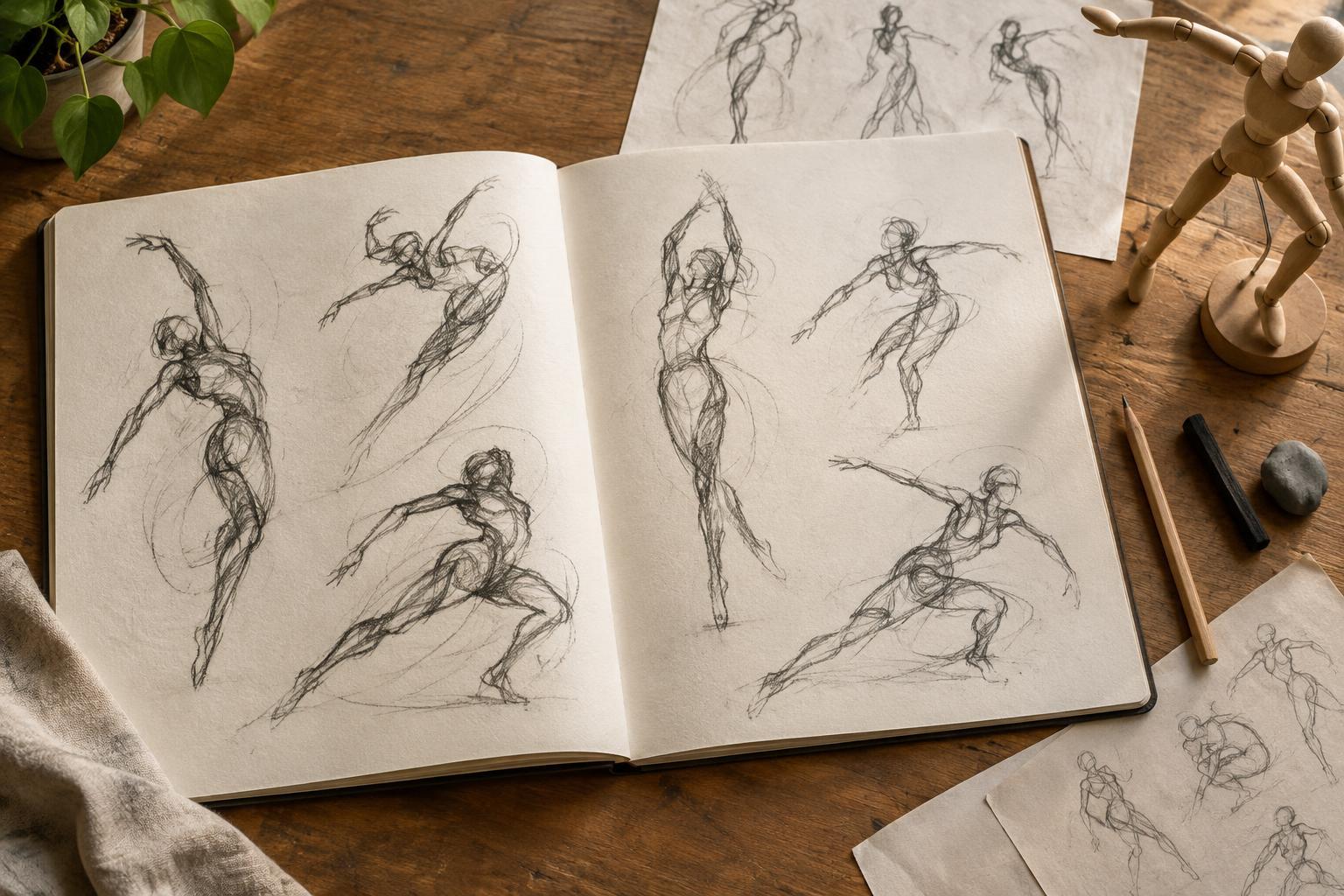
A gesture drawing is a quick study of a pose’s overall action. Its purpose is not to record every contour or produce a finished figure. It asks a simpler question: what is this body doing? A person reaching for a shelf, turning to look behind them, or settling into a chair may have a recognizable silhouette, but the force of the pose comes from how its parts relate. Gesture helps you notice that relationship before details compete for your attention.
Start by looking at the whole figure for a few seconds without drawing. Notice where the weight rests, which way the torso leans, and whether the limbs extend, fold, or pull against one another. Then make a small mark that describes the dominant direction of the pose. It might sweep from head to planted foot, or curve through the spine toward an outstretched arm. This line of action is a guide, not a bone or an outline. If one line cannot describe the pose, use two or three connected strokes rather than forcing it.
Build a pose from simple relationships
Once the action is visible, place the head, rib cage, and pelvis as simple shapes. An oval and two loose blocks are enough. Pay attention to their angles: a tilted rib cage over a level pelvis suggests a different movement from two shapes leaning together. Connect them with a flexible center line, then indicate the arms and legs with economical strokes. At this stage, a bent elbow or knee matters more than the exact shape of a sleeve or muscle.
Check the pose against gravity. Find the foot, hand, or seat carrying the body’s weight, and imagine a vertical line running down from the torso. Does the figure seem supported, or is it falling in a way the reference does not suggest? For a moving pose, support may be brief or shared between points. You do not need to solve the mechanics perfectly, but noticing where the body pushes, hangs, or lands can make a sketch feel more convincing.
Use a short sequence of timed sketches
Choose a reference you can observe clearly, such as a person posing, a paused video frame, or your own reflection. Begin with several very short sketches of different poses. In each, spend most of the time finding the action and only a little time adding body masses. Resist the urge to repair every line. The limit encourages decisions about what matters most.
Next, give yourself a little longer with each pose. Add the direction of the shoulders and hips, the major bends of the limbs, and one or two marks that show where weight meets a surface. Finally, return to a pose you found difficult and draw it again at a comfortable pace. Compare the attempts: did the longer version become clearer, or did extra detail weaken the movement? The exercise works best when each drawing gives you something specific to look for in the next one.
Look for rhythm rather than perfect contours
A lively pose often contains alternating directions. One side of a bent torso compresses while the other stretches; one arm may lead outward while the opposite leg anchors the figure. Look for those contrasts. Long strokes can carry your eye through the pose, while shorter marks can show a sharp turn at a joint. Try drawing across the figure when a movement connects distant parts, such as a reaching hand and a trailing foot.
Avoid tracing the outer edge of the body all the way around on your first pass. A careful outline can describe shape yet miss the shift of weight inside it. Likewise, making every limb equally dark gives each mark the same importance. Use firmer lines for the main action and support points, and lighter lines for uncertain placements. Overlapping strokes are acceptable when they help you search; they need not be cleaned into a single contour.
Turn quick studies into a useful habit
Gesture drawing is easier to practice when the goal is narrow. Fill a page with seated poses and study how the torso meets the chair, or draw several walking poses and focus only on which leg supports the weight. If faces and clothing distract you, leave them out for a session. You can also repeat one pose at different sizes to see whether its action still reads when reduced to a few marks.
After a page of sketches, choose one that feels active and one that feels stiff. Ask what differs: the angle between torso and pelvis, the placement of the feet, or the direction of your first stroke? Make a fresh version of the stiff pose with one deliberate change. Gesture drawing becomes more useful when quick marks lead to observation, and observation leads to a clearer next attempt.