Aim for recognition, not identical drawings
A character rarely looks exactly the same in two comics panels. Their pose, expression, distance from the reader, and angle to the imaginary camera all change. Consistency means preserving the features that let readers recognize them while allowing the drawing to serve each moment. A surprised face can stretch; a running figure can lean. The goal is not to trace a model sheet into every frame.
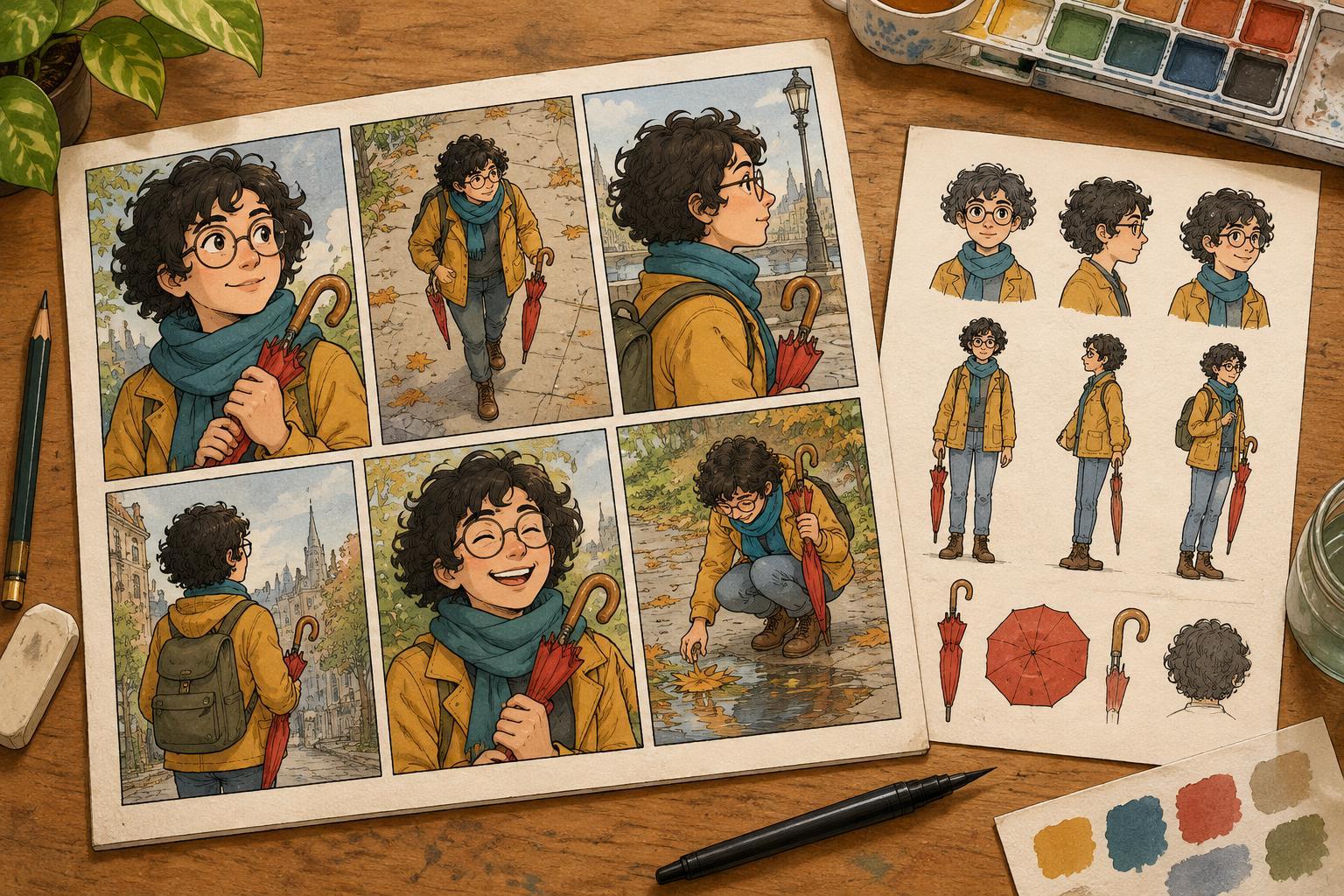
Start by choosing a few visual anchors for each recurring character. These might be a distinctive hair shape, a particular jacket collar, a broad shoulder-to-hip relationship, or the way their shoes taper. Prioritize shapes a reader can spot at a glance. If a feature disappears in a close-up or rear view, another anchor should remain. This is especially useful when several characters share similar clothes or body types.
Build a small reference sheet before drawing the page
A reference sheet does not need to be elaborate. Draw the character from the front, side, and back, then add a few expressions and poses that are likely to appear in the scene. Note relationships rather than relying only on measurements: where the eyes sit relative to the ears, how far the coat falls below the hips, or whether the hair rises above the crown or hugs it. Relationships are easier to carry into a new angle than a fixed set of numbers.
Give important props the same treatment. Sketch a bag, tool, phone, or piece of furniture from more than one side. Mark details that must survive a turn, such as which shoulder holds a strap or where a clasp sits. Keep the sheet close while thumbnailing and penciling. It is easier to check a decision before a panel is polished than to repair an entire sequence afterward.
Track what changes from panel to panel
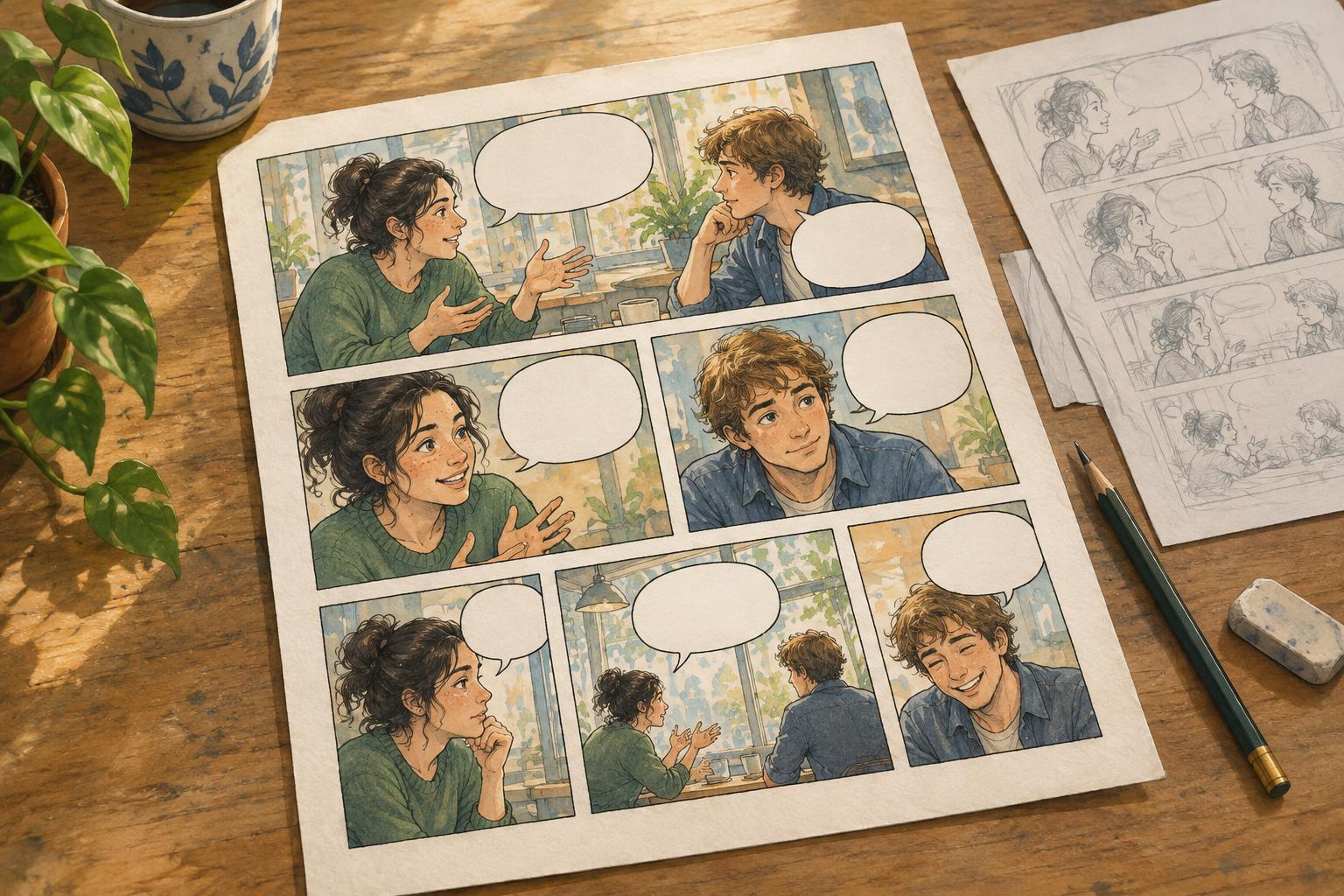
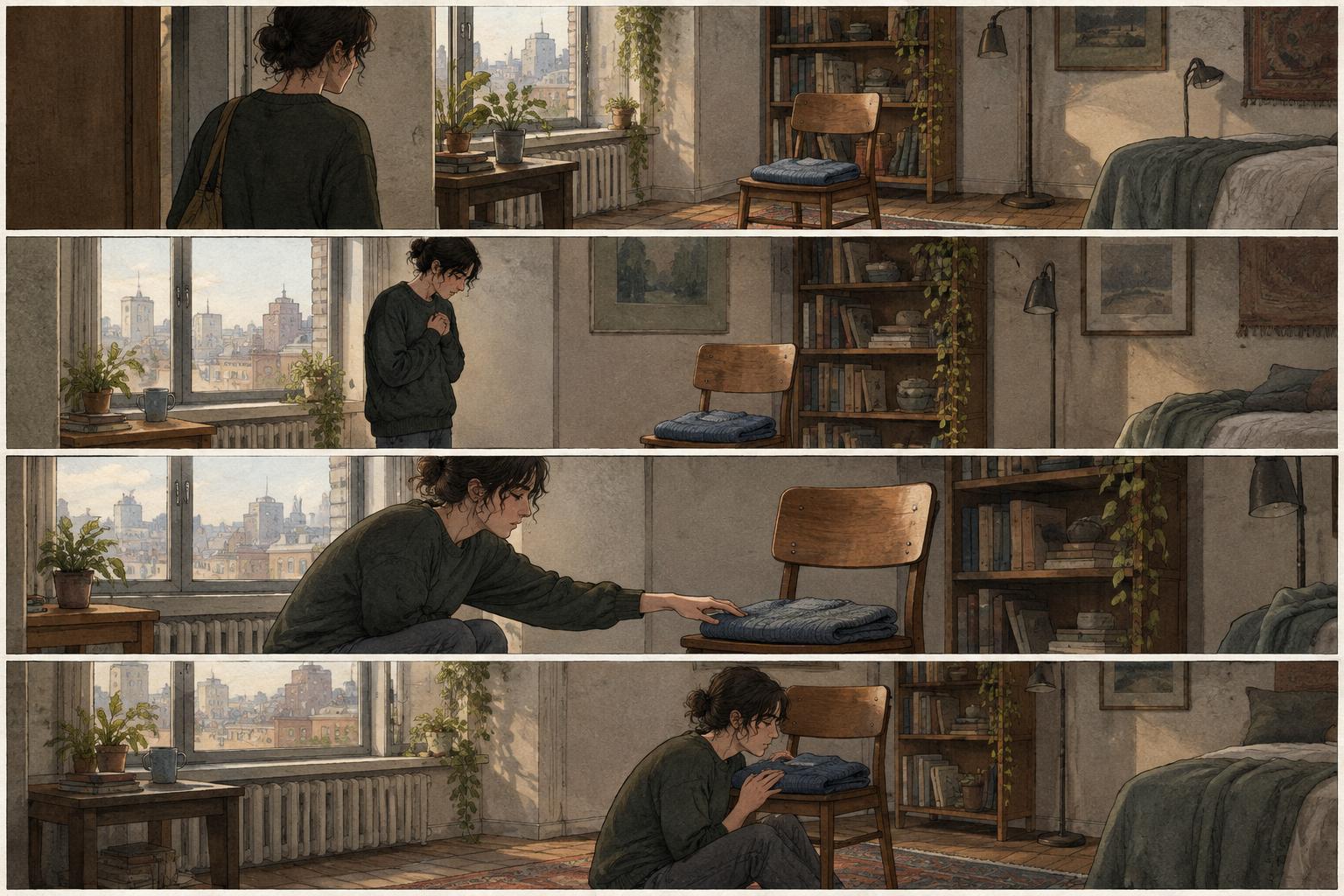
Design consistency and story continuity are related but different. A jacket can be drawn accurately in every panel while its sleeve inexplicably rolls up and down. For each scene, identify details that can change through action: a character picks up a cup, opens a door, removes a hat, or moves a chair. The next panel should reflect that action unless the transition deliberately skips time.
A short continuity list can help. Write down which hand holds an object, where the characters stand, whether a door is open, and what is visible on a table. Update the list as the scene develops. For complex exchanges, make a quick overhead sketch of the space and mark the characters’ positions. This gives you a stable starting point when you switch between wide shots and close-ups, without forcing every panel to use the same viewpoint.
Use the page to catch drift
Panels are often drawn one at a time, but readers encounter them as a sequence. Step back and view the whole page at a small size. Does a character’s head suddenly become much larger relative to their shoulders? Does a backpack seem to change shape? Are two characters still distinguishable when facial details are too small to see? At this scale, shifts in silhouette and proportion can be easier to notice than they are while zoomed into a single drawing.
Then scan the page for one element at a time. Follow the main character’s hair through every panel, then their clothing, then the recurring prop. This focused pass reduces the chance of overlooking a small change because your attention is on the dialogue or action. If a panel breaks continuity, first ask whether it harms clarity. A tiny button difference may not matter; a cup jumping between hands might confuse the movement.
Leave room for expressive variation
Not every deviation is an error. Comics can exaggerate a face for a joke, simplify clothing in a distant shot, or reshape a pose to make an action legible. Keep the character’s strongest anchors in place and let less important details flex. Props can also be simplified at small sizes, provided their defining shape and role remain clear.
A useful final exercise is to take three neighboring panels and cover the dialogue. Check whether you can still tell who is present, where the important object is, and what changed between moments. If the sequence reads, your consistency choices are doing their job. If it does not, revise the anchors or the staging before adding more detail.