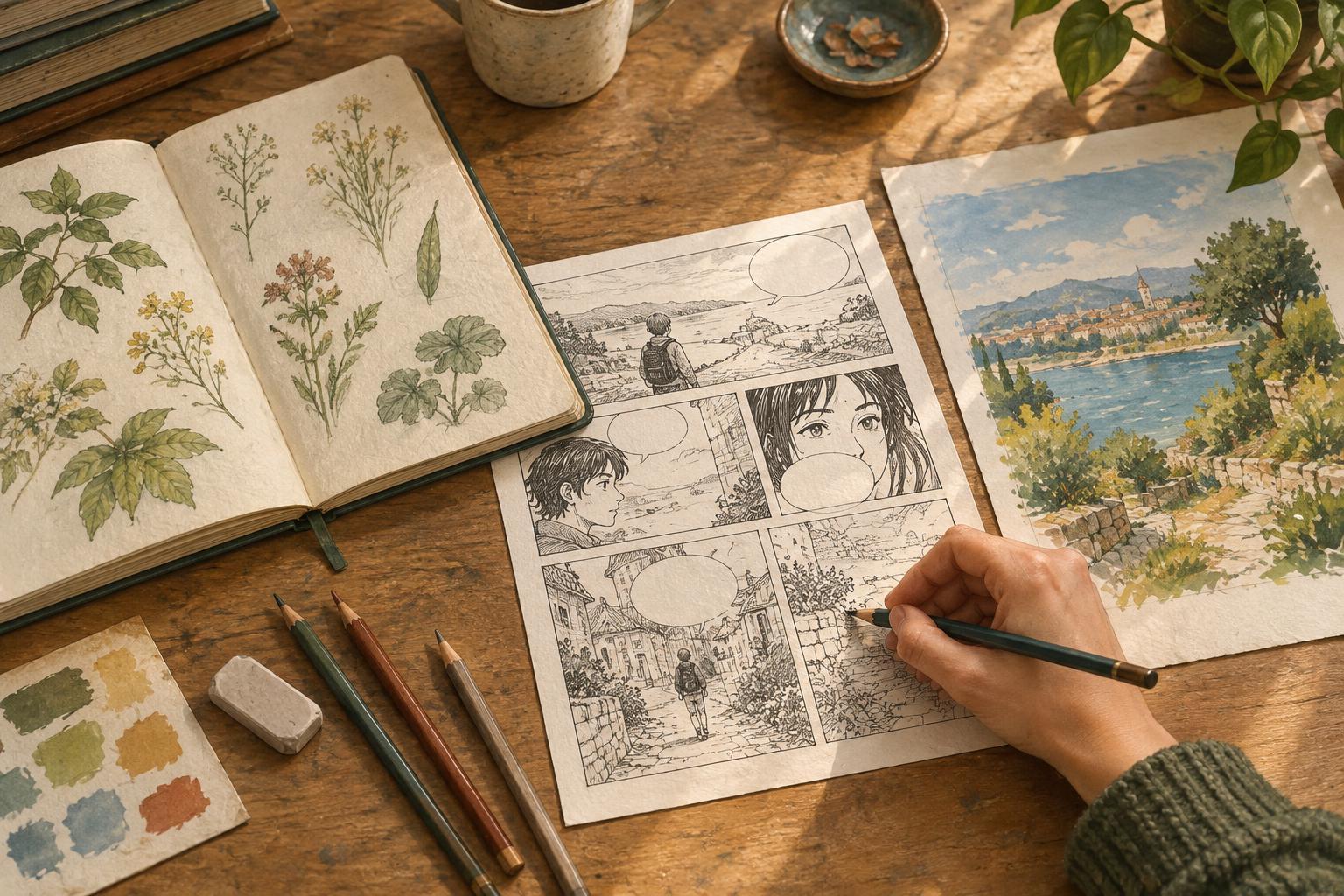
Why the beginning feels so demanding
A blank page leaves many possibilities open. Once a mark appears, it can seem as though the drawing has to live up to the image in your head. That pressure is especially strong when you care about the idea: a character you have imagined clearly, a scene with a particular mood, or a sketch intended to become a finished illustration. Perfectionism at this stage often looks less like careful drawing and more like hesitation. You redraw the same contour, avoid placing the main shapes, or keep searching for a better idea before testing the one you have.
The early stage has a different job from the final stage. Its purpose is to discover what the drawing needs, not to prove that every choice was right from the start. A rough figure may reveal that the pose lacks energy. A simple arrangement of boxes may show that the focal point is too close to the edge. These are useful findings, not failures. Treating a first pass as a way to gather information makes it easier to put something on the page.
Give the first pass a limited assignment
Before drawing, decide what the next few minutes are for. You might test the silhouette of a character, place the largest light and dark areas, or work out where two figures stand in relation to each other. Choose one question that a rough drawing can answer. If you try to solve anatomy, expression, composition, clothing and texture at once, every mark can feel consequential. A narrow assignment gives you permission to leave other problems unresolved for now.
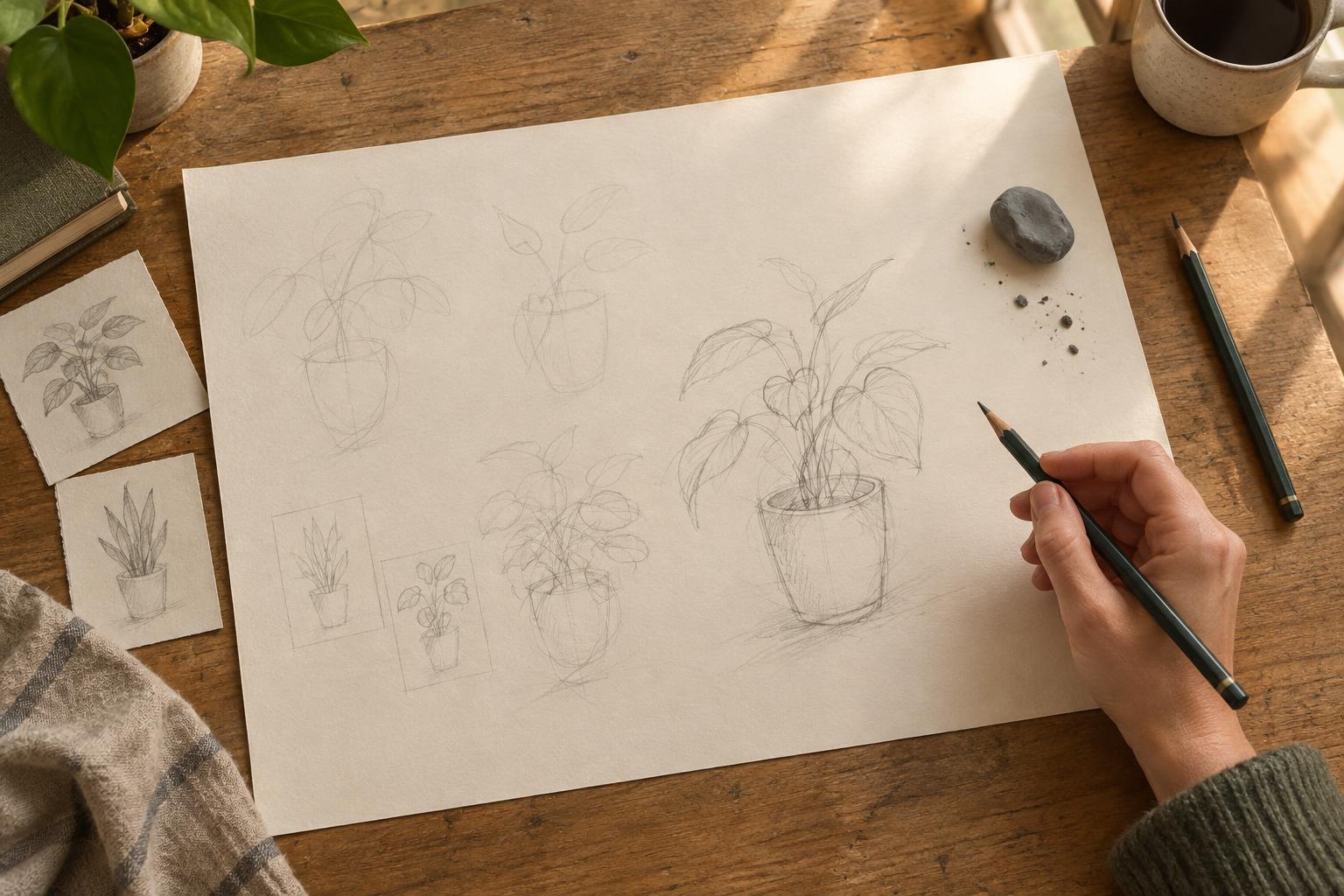
Match the tools to that assignment. Small thumbnail drawings are useful for composition because they make detail difficult. A broad pencil, loose brush or large digital brush can help you concentrate on masses rather than individual lines. If you are working digitally, consider postponing the zoom-in. If you are working on paper, leave room in the margin for an alternate version. Neither approach guarantees a better result; both make experimentation less costly.
Separate exploring from refining
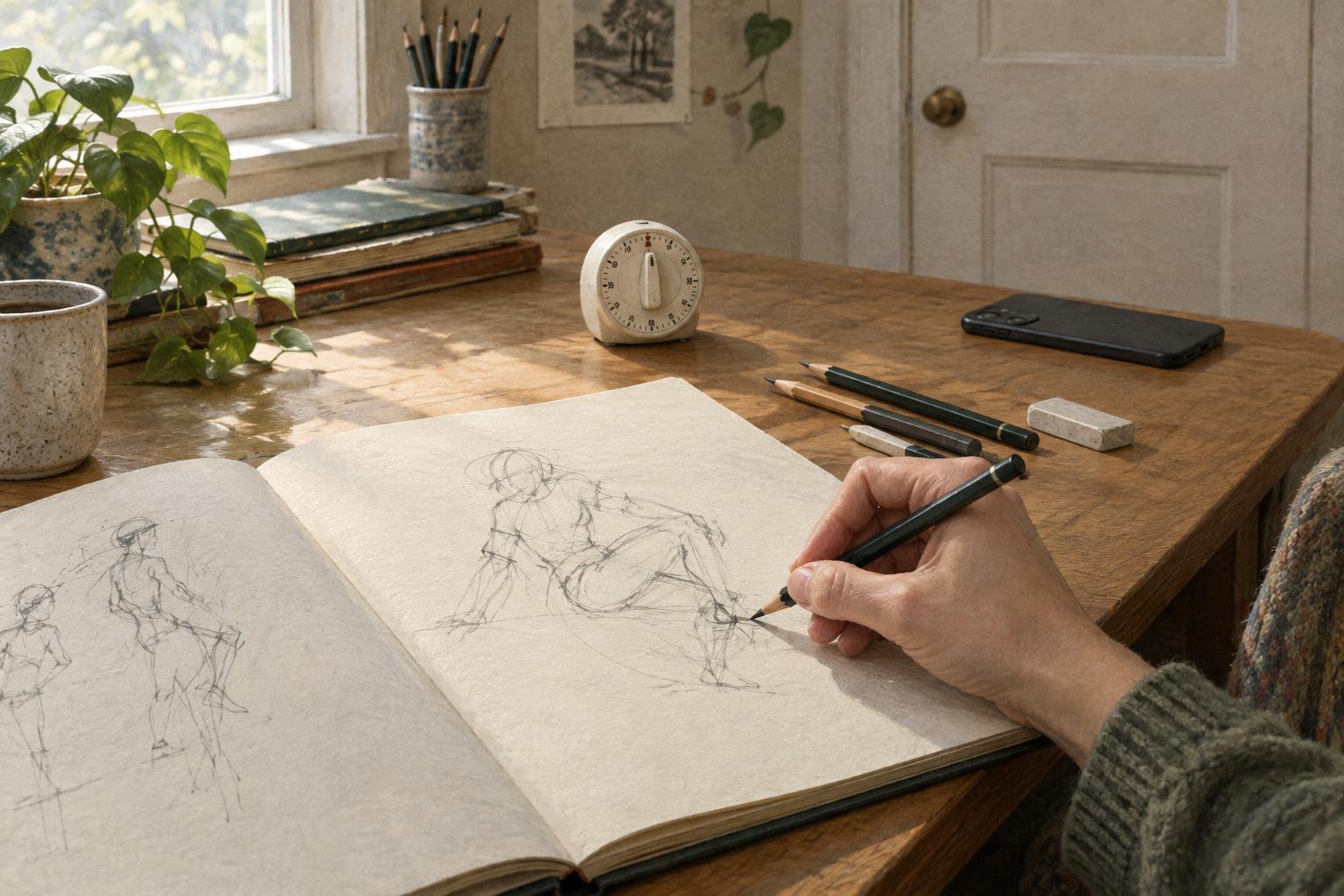
Exploration and refinement call for different kinds of attention. In exploration, make several quick versions of a gesture, layout or shape without stopping to repair each one. In refinement, select a direction and check its proportions, edges and details more carefully. Switching between these modes after every stroke can slow the drawing down: you begin to polish an idea before you know whether it works.
Try setting a simple checkpoint between the two modes. Make three small options, then ask which one best communicates the action or mood you want. The options need not be equally good, and you do not have to combine them. Once you choose one, name the reason: perhaps the pose reads more clearly or the empty space gives the scene room to breathe. A specific reason is more helpful than the vague hope that one sketch is somehow perfect.
Use revisions to answer questions, not erase discomfort
Revision is part of drawing, but repeated revision can become a way to avoid moving forward. When you feel the urge to start over, pause and identify the problem in observable terms. Is the head too large for the body? Is the character’s gaze leading out of the frame? Does the image feel flat because the foreground and background have similar values? A named problem suggests a test. A general feeling that the drawing is wrong often does not.
Make the smallest change that could test your diagnosis. Shift a shape on tracing paper, redraw a gesture beside the original, or cover a section temporarily and sketch an alternative. Keep the earlier version visible until you can compare them. If the change improves clarity, carry it forward. If it does not, you have learned something without having to rebuild the whole piece. Starting over remains an option, but it becomes a deliberate choice rather than an automatic response to uncertainty.
Make room for an unfinished drawing to develop
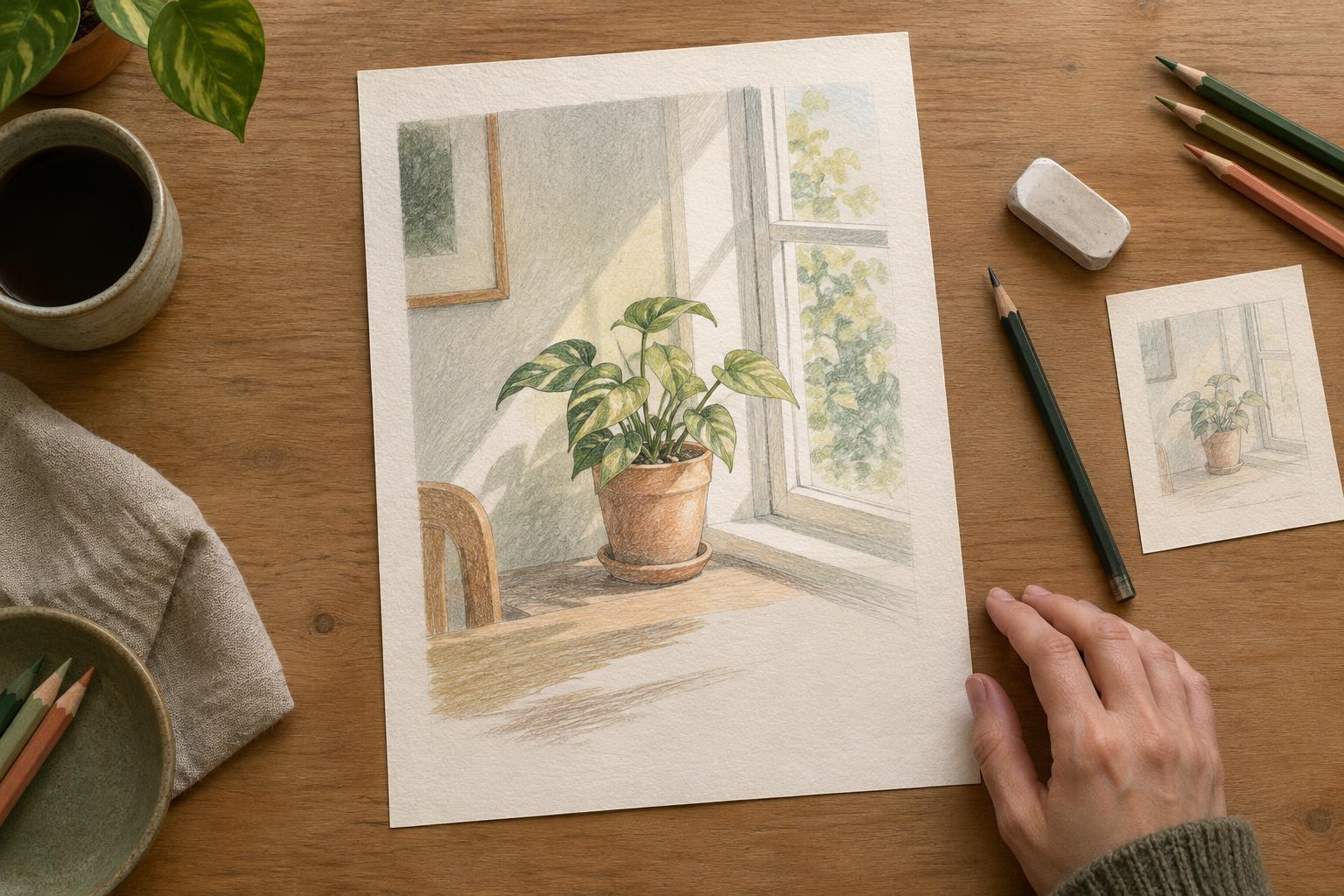
Some awkwardness is normal while a drawing is being built. Construction lines may cross, a face may be no more than a directional mark, and a scene may need several passes before its parts relate convincingly. It helps to decide in advance what counts as enough for the current stage. For example: the main action is readable, the largest shapes fit on the page, and you know what to examine next. Meeting that standard is a reason to proceed, even if the sketch is not yet attractive.
At the end of a session, leave a short note about your next step: “check the hand position” or “try a darker background behind the figure.” This turns a vague unfinished feeling into a manageable task when you return. Managing perfectionism does not mean ignoring quality. It means giving each stage the kind of attention it can use, so that care supports the drawing instead of preventing it from beginning.