Start with the marks, not the brush aisle
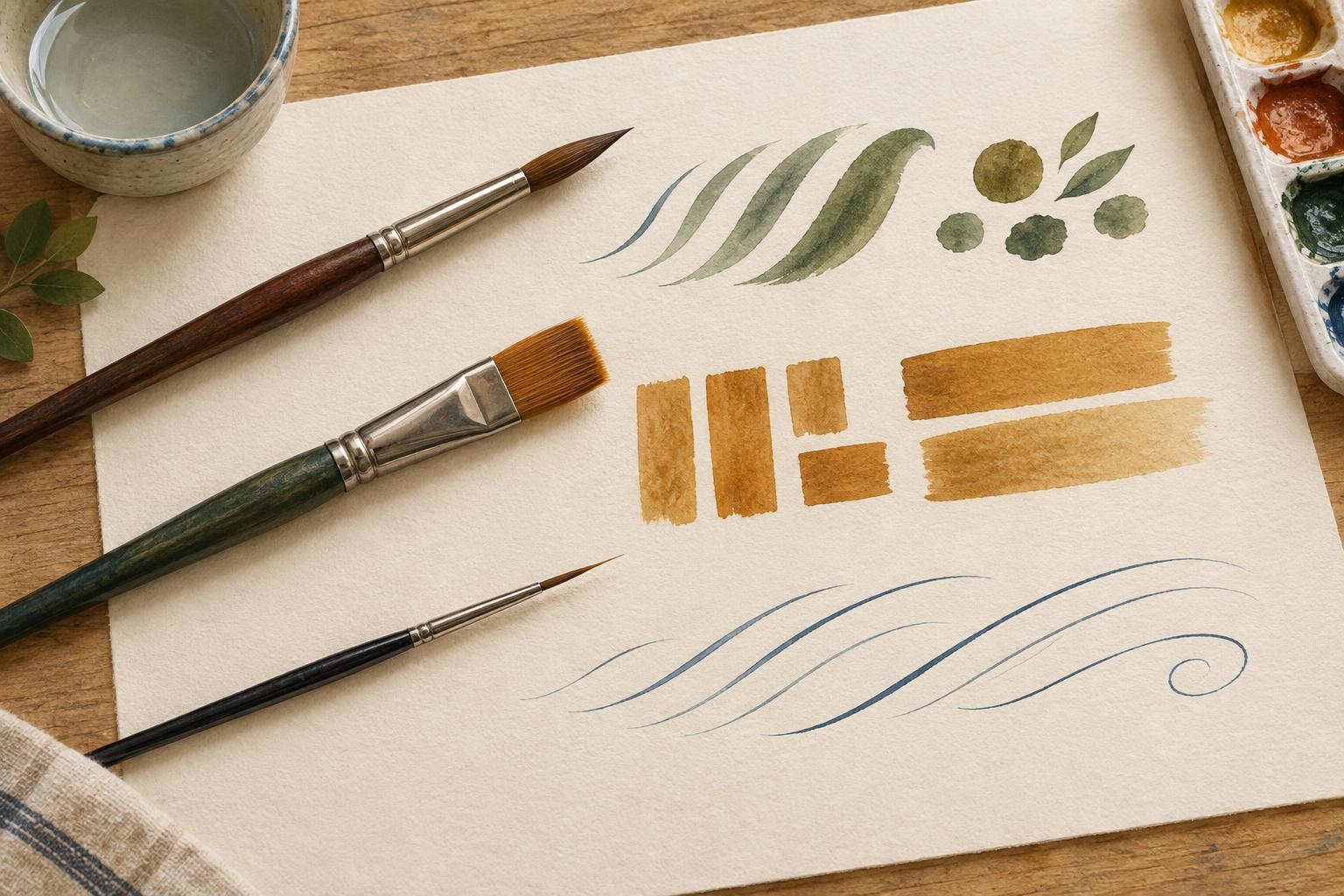
A brush is easier to choose when you know what mark you want to make. Do you need a broad block of color, a line that changes thickness, or a long, narrow stroke? Round, flat and liner brushes answer those needs in different ways. None is the best brush for every illustration. Their shapes simply make certain movements easier to repeat.
Before comparing them, notice four useful features. The tip or edge determines the shape of a careful stroke. The belly, the fuller part of the bristles, holds paint or water. Spring describes how readily the bristles return to shape after bending. Size affects both coverage and control, but numbered sizes are not consistent across brands. If possible, judge a brush by its actual width and length rather than its number alone.
Round brushes: flexible lines and small shapes
A round brush gathers into a point and widens behind it. With light pressure, a pointed round can draw a fine line; with more pressure, its belly can make a wider stroke. That range makes rounds useful for contours, lettering-like gestures, small filled shapes and details in a character’s face or clothing. A larger round may also cover more area than its point suggests, especially when it holds a good amount of paint.
The useful test is whether the tip comes back together after you lift the brush. A round with a damaged or splayed point can still make lively textures, but it will be less predictable for precise lines. Try drawing one continuous stroke that moves from thin to thick and back again. If that feels difficult, slow down and change pressure gradually rather than trying to steer with your fingertips alone.
Flat brushes: edges, blocks and deliberate strokes
A flat brush has bristles arranged in a wide, straight edge. Held face down, it lays a band of color; turned onto its narrow side, it can make a thinner line. Flats are handy for filling backgrounds, building rectangular shapes and placing crisp edges against a silhouette. Their visible brush marks can also become part of an illustration’s texture.
A flat brush is less suited to tight curves than a pointed round, though that limitation can be useful. Constructing a tree, building or figure from short flat strokes encourages you to think in simple shapes. For an exercise, paint the same object twice: once using only the broad face and once alternating between the face and the edge. Notice how brush orientation changes the drawing without changing the paint.
Liner brushes: long strokes with a light hand
A liner has a small bundle of bristles that is noticeably longer than that of a typical round. The length helps it carry paint along a slender stroke, which can be useful for hair, grasses, wires, decorative marks and flowing contours. It may feel less immediately responsive than a short round because the tip follows your hand with a little more movement.
Liners work best when the paint flows easily enough to leave the bristles without constant pressure. If a line breaks, try adjusting the paint’s consistency in a way that suits your medium, then test it on scrap paper before returning to the artwork. Pulling a stroke with your whole arm, rather than tracing it through tiny finger movements, can help create a smoother curve. Let the natural variation remain; a liner is a tool for expressive lines, not a guarantee of perfectly uniform ones.
Choose a small set and learn what it can do
A beginner does not need every size of every shape. A medium round, a flat wide enough for the areas you usually fill, and a liner for occasional long details make a practical starting set. Choose brushes intended for your paint medium: a brush that feels good with watercolor may not behave the same way with thicker acrylic or oil paint. Handle comfort and bristle response matter more than owning a complete range.
Make a simple test sheet for each new brush. Draw a thin line, a thick line, a curve and a filled shape; then repeat with a different angle or pressure. Label the marks so you can compare them later. After painting, clean brushes using the method appropriate to the paint, avoid leaving them standing on their bristles, and reshape the tips while damp. Familiarity with a few well-kept brushes will usually teach you more than a drawer full of unfamiliar ones.