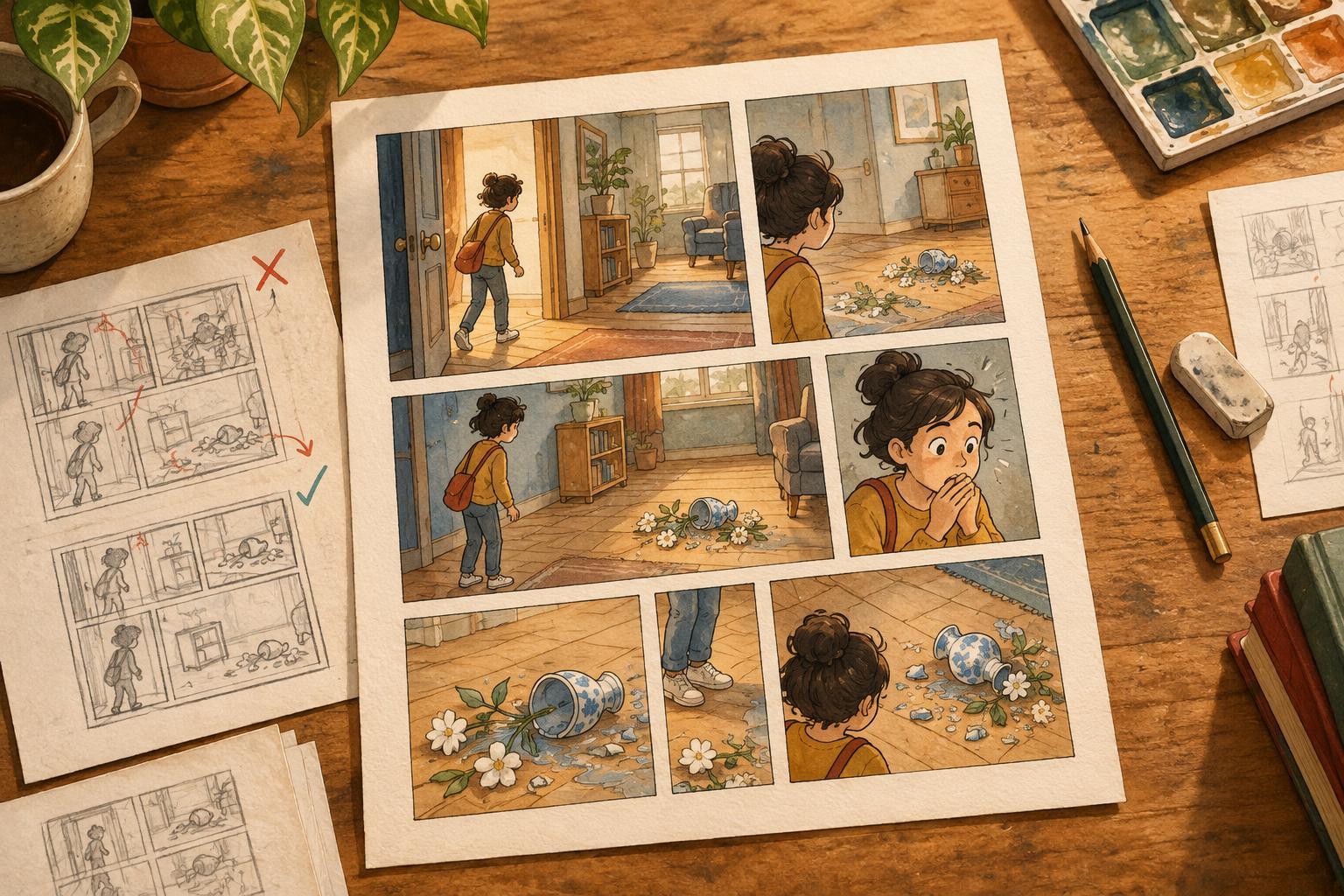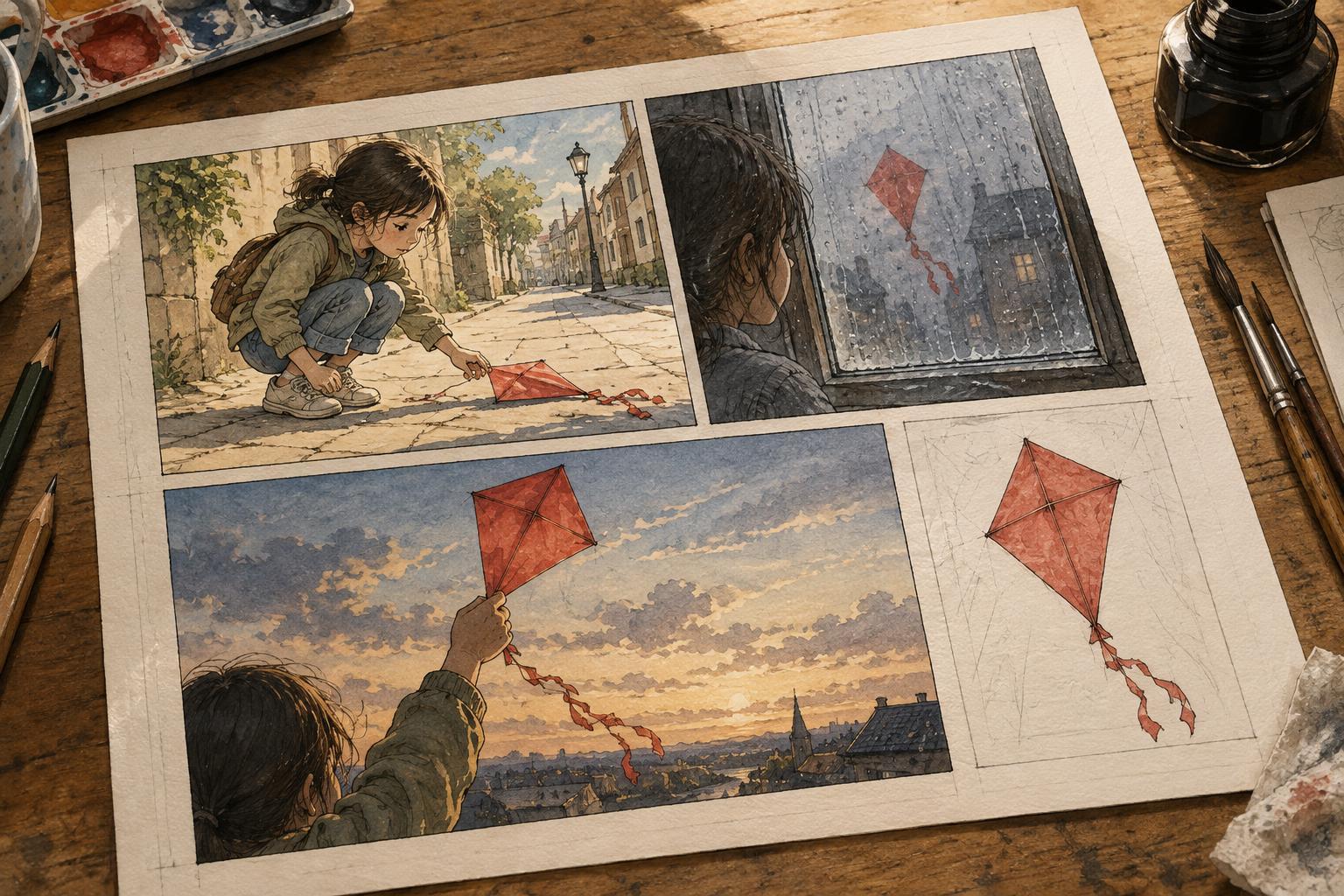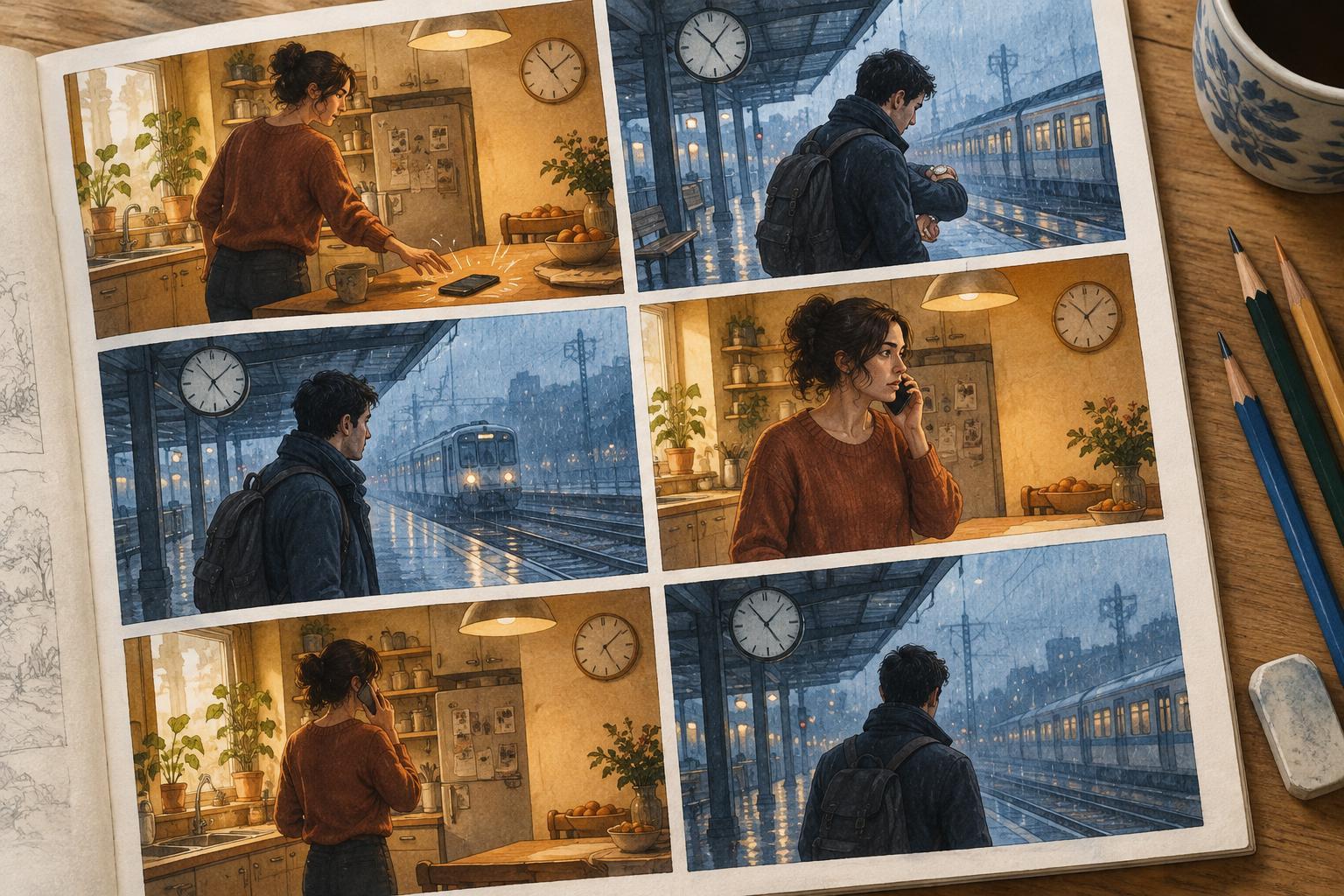
Give each scene a recognizable home
Parallel scenes ask readers to hold two threads in mind. Before switching between them, make each location easy to recognize. An establishing panel need not be wide or elaborate: a particular doorway, window shape, street sign, or arrangement of furniture can be enough. When the story returns to that place, repeat one of those cues. The reader can then recognize the setting before reading the dialogue.
Character placement can provide another anchor. If one scene centers on a person at a crowded table and the other follows someone alone on a staircase, preserve those relationships through successive panels. Clothing silhouettes, props, and the direction a character faces can also help. Distinction works best when it grows from the story world rather than from an arbitrary visual code that readers must memorize.
Decide what each switch should accomplish
A switch is most useful when it changes the reader’s understanding. One scene might pose a question that the other answers, or show a quiet action while another scene suggests its consequences. A cut can also build anticipation: leave a hand reaching for a latch, then follow the person on the other side of the door. If every switch happens merely because both scenes need equal space, the sequence may feel busy without gaining tension.
Before drawing, write a short beat list for each thread. Mark the moments when the threads connect through a shared event, a contrast, or a cause-and-effect relationship. Then alternate at those points rather than on a fixed schedule. A scene may need several panels to make an action legible; another may need only one panel to show a reaction. Simultaneous does not have to mean equal panel counts.
Make the first panel after a cut do extra work
The panel immediately after a switch should answer a basic question: where are we now? Bring back a familiar landmark, show a recognizable character, or choose a camera angle that quickly reestablishes the space. When a return panel opens on an extreme close-up of an unidentified object, readers may need to backtrack. Save that kind of ambiguity for moments when uncertainty is the intended effect.
Panel composition can signal a cut without relying on captions. A busy kitchen and an open rooftop, for example, have different densities of detail and different shapes in the background. Keep the shift clear enough to notice but consistent enough with the rest of the comic to feel like part of the same story. If color is available, a limited difference in palette can reinforce the locations, but the sequence should not depend entirely on color to be understood.
Keep the timeline readable
Alternating panels do not automatically tell readers that events are simultaneous. They may interpret the second scene as happening later, especially if nothing links the two. A shared cue can clarify the relationship: the same alarm sounding in both places, a brief power outage, or one character seeing the result of an action in the other scene. Use such cues sparingly and place them where they orient the reader, not in every panel.
Be mindful of how much action fits into each thread. If one character crosses a building while the other completes a single gesture, a rapid back-and-forth may imply that both actions took the same amount of time. You can solve this by showing only selected moments, allowing a pause in one scene, or making it clear that time has passed before returning. Exact synchronization is rarely necessary; the important thing is that the sequence does not accidentally suggest an impossible order of events.
Test the sequence without its dialogue
Thumbnail the pages and follow only the images. At each cut, ask whether you can identify the location and the current character at a glance. Then read the panels in their likely viewing order. An inventive layout is less effective if it sends the eye to the wrong scene first. If a transition feels uncertain, try strengthening the return panel or simplifying the page arrangement before adding explanatory text.
For a focused exercise, draw two six-panel sequences showing the same pair of events: a person preparing to leave a room and another person approaching it. In the first version, switch after every panel. In the second, switch only when a new action changes what the reader expects. Compare where you hesitate, what you anticipate, and which version makes the timing easiest to understand. The goal is not to find one correct rhythm, but to make every cut a choice the reader can follow.