What the letters on a pencil tell you
Graphite pencils are labeled by the hardness of their cores. H stands for hard: an H pencil generally makes a lighter, finer mark and holds its point longer. B stands for black: a B pencil generally has a softer core that lays down more graphite and makes a darker mark with less pressure. HB sits near the middle of the range and is a useful all-purpose pencil. You may also see F, meaning fine point, on a pencil intended to hold a relatively fine tip.
Numbers show the direction and degree of the grade. A 2H pencil is harder than an H pencil; a 4B pencil is softer than a 2B pencil. The farther you move along either side of the scale, the more noticeable the difference tends to be. These labels are guides rather than exact measurements: two brands marked 2B may feel different on the same sheet of paper.
How hardness changes a drawing
A harder pencil is handy when you want a restrained line. Light construction marks, measured shapes and small details can be easier to control with an H-grade pencil. Because it deposits less graphite, however, it may tempt you to press harder when you want a dark line. Heavy pressure can dent the paper, making later erasing or shading more difficult.
A softer pencil can build dark values quickly. It suits bold outlines, broad shading and accents that need to stand out. Its point wears down sooner, and heavy applications may smudge or develop a slight sheen. Neither family is inherently better for finished work: the useful grade depends on the mark you want and how you prefer to build it.
Choose a small working set
You do not need every grade in a pencil range to start drawing. Try an HB for everyday sketching, a 2H or H for light planning lines, and a 2B or 4B for darker shading. This small set gives you distinct options without asking you to switch pencils for every mark. If your drawings rely on very dark areas, you can try a softer grade later; if they rely on precise, pale lines, add a harder one instead.
Match the pencil to the task, not just to the subject. For a comic panel, you might lay out figures with a light pencil, clarify forms with HB, then use a softer pencil to test where the strongest darks belong. For a tonal study, begin with the middle values and reserve the softest pencil for the darkest passages. Keeping those passages limited can help the drawing retain a clear range of light and dark.
Paper and pressure matter too
A pencil grade does not determine the result by itself. Smooth paper tends to show crisp lines and small changes in pressure. More textured paper can catch graphite on its raised surface, creating a grainier mark. Erasing, blending and repeated layers can change the surface as you work. If a pencil seems unexpectedly scratchy or faint, try it on another sheet before deciding that the grade is wrong for you.
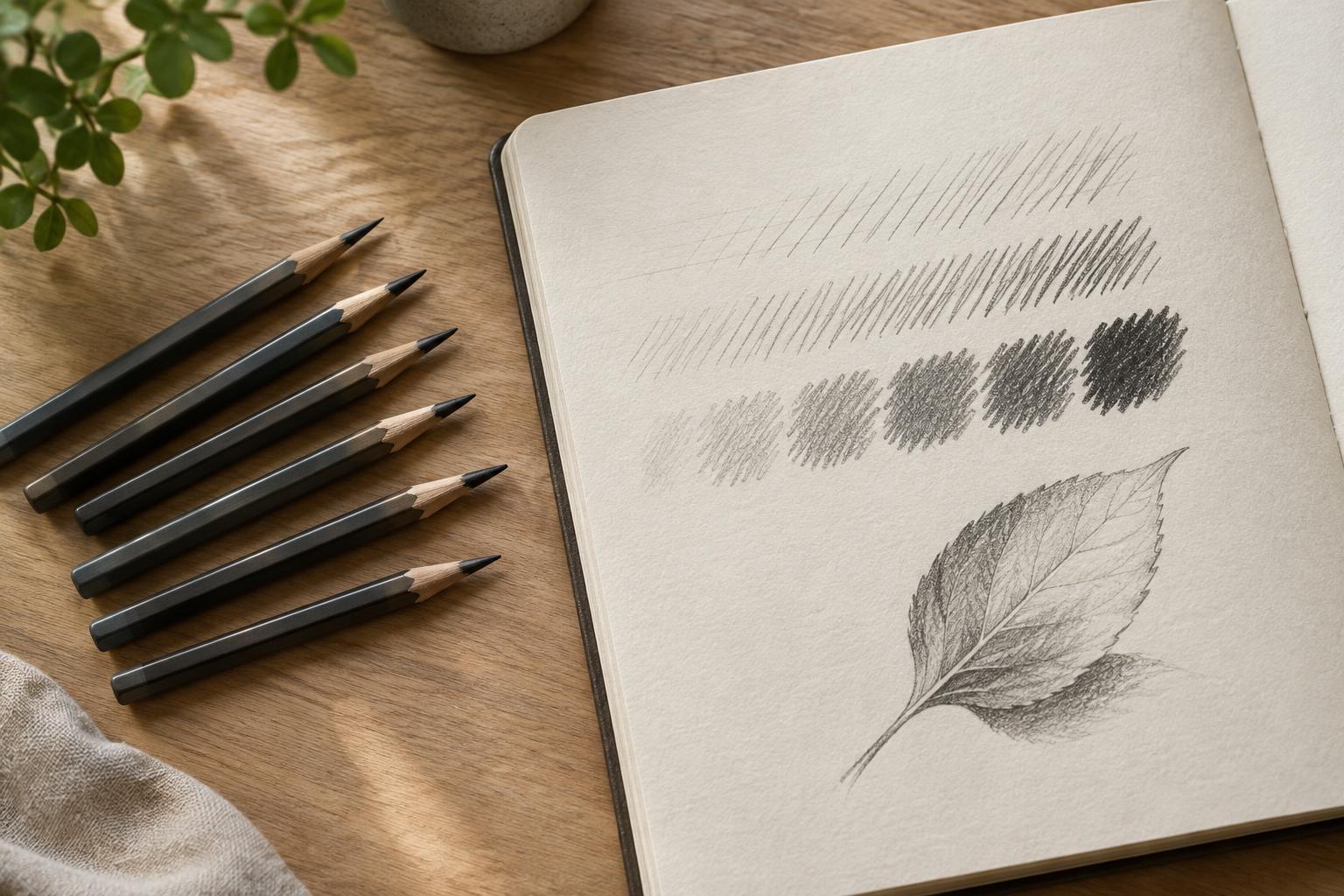
Pressure is another variable worth practicing. Draw five lines with one pencil, starting with the lightest touch you can control and gradually increasing pressure. Then repeat with a harder and a softer grade. Notice where each pencil makes a dark mark comfortably, where the point begins to flatten, and whether the paper surface changes. This quick test teaches you more about your particular pencils than the labels alone can.
Make your own grade reference
On the paper you use most often, draw a small swatch for each pencil you own. Include a light line, a firm line and a shaded patch for each grade, and write its label beside the marks. Use ordinary drawing pressure rather than trying to force every pencil to reach the same darkness. Your swatches will show the range each pencil offers in your hands.
Keep the sheet nearby when choosing tools for a new illustration. If a pale sketch is hard to see, you may need HB rather than a harder pencil. If your shading looks too uniform, a softer grade may give you a darker accent without excessive pressure. Pencil grades are not rules for how to draw; they are a compact way to predict how a tool might behave, then test that prediction on the page.