Give the blank page a boundary
“Draw anything” sounds freeing, but it also asks you to make every decision at once. You have to choose a subject, a viewpoint, a mood, a medium and a reason for the image to exist. A creative constraint removes one or more of those decisions. Instead of limiting imagination, it gives imagination something specific to work against.
A useful constraint is clear enough to affect the drawing but open enough to allow several answers. “Draw a character” is broad; “draw a character carrying something too large to hide” suggests action, scale and possible story. The object could be a ladder, a birthday cake or a sleeping dog. Each choice leads to a different image while keeping the starting point manageable.
Try treating constraints as temporary tools rather than rules about how your work should look. If a limit helps you begin, it has served its purpose. If it makes the image less interesting after a few sketches, change it. The aim is to produce possibilities, not to prove that you can obey an arbitrary instruction.
Choose one strong limit and one surprise
Start with a single constraint in a familiar area: subject, setting, composition, color, material or time. You might illustrate an ordinary errand, keep every important shape inside a circle, use only two colors, work with one brush, or make six thumbnails in ten minutes. Each limit directs your attention differently. A color limit encourages value and shape decisions; a time limit encourages quick choices instead of careful rendering.
Then add one element that creates a question. Combine “an ordinary errand” with “a place where gravity behaves strangely,” or pair “two colors” with “a celebration that has gone wrong.” A practical prompt formula is: familiar action plus unusual condition plus visible consequence. For example, a person watering houseplants in a room that is slowly flooding suggests objects to draw, an atmosphere to establish and a moment to capture.
Keep the combination small enough to remember without a checklist. Too many requirements can turn sketching into problem solving for its own sake. If the prompt contains a character, three props, a particular perspective, a color palette and a required ending, remove a few elements. Leave space for discoveries made while drawing.
Use thumbnails to test what the constraint reveals
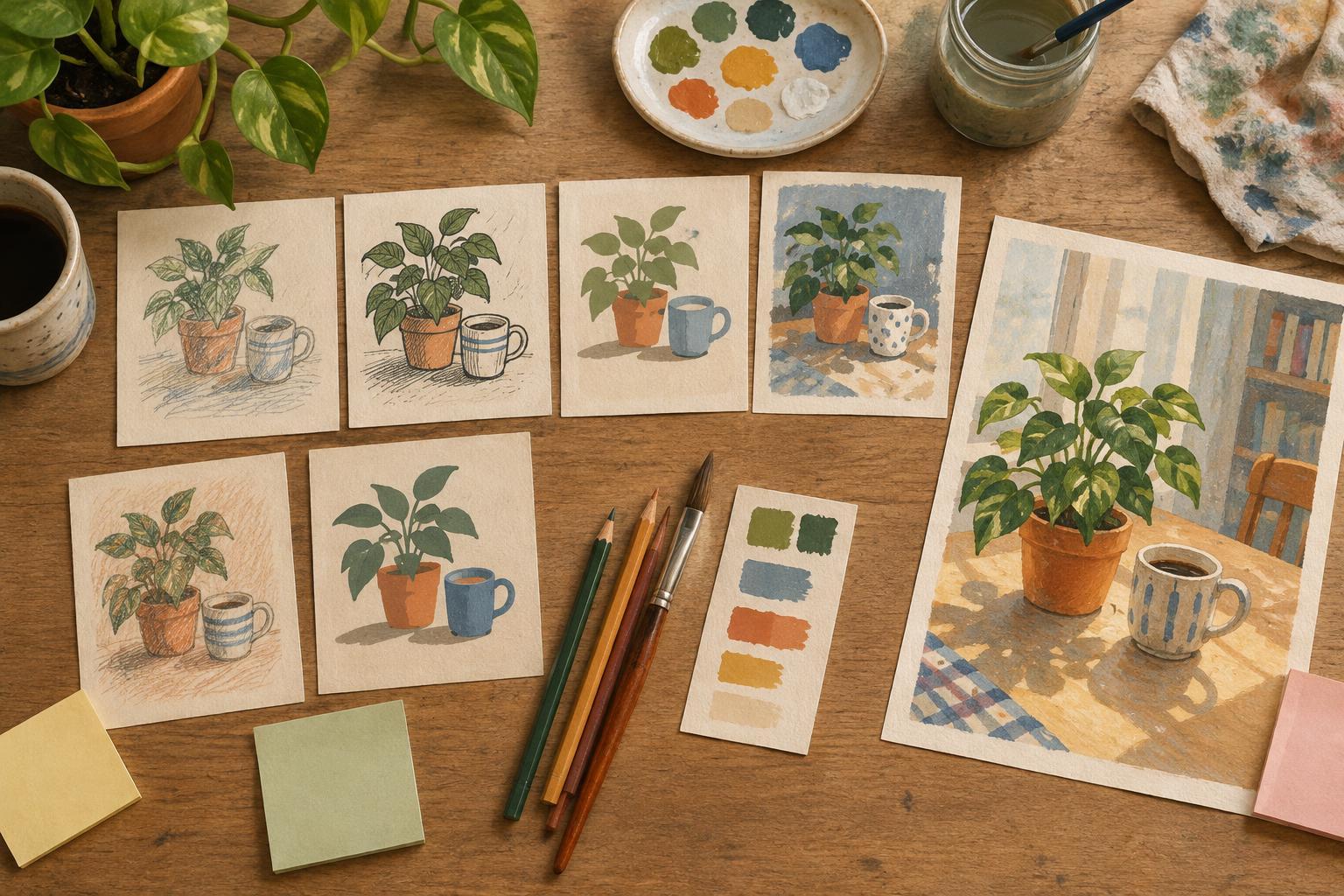
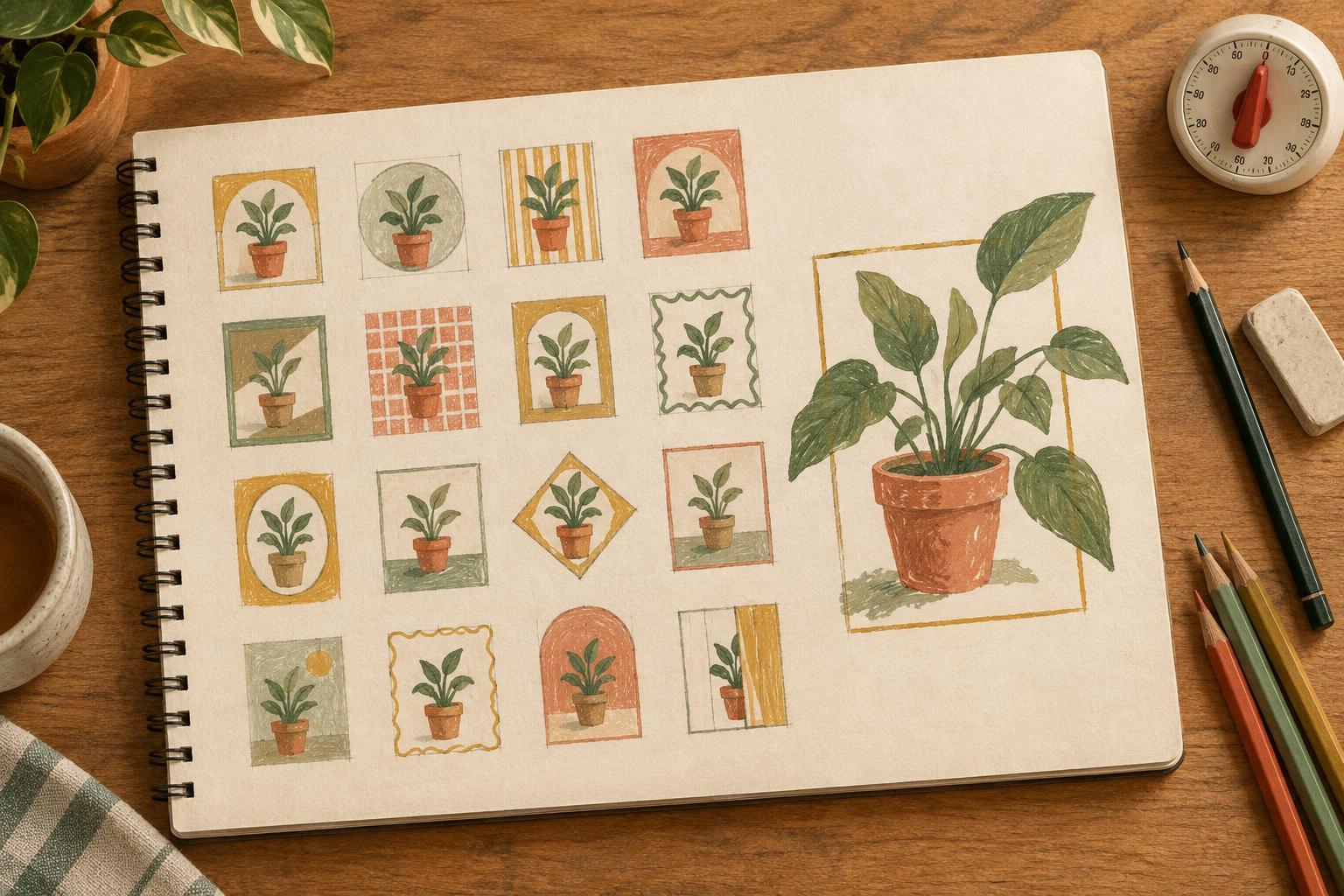
Before committing to a finished illustration, make several small thumbnails from the same prompt. Change only one major decision at a time. Show the scene from far away, then close to a character’s hands. Move the main shape from the center to an edge. Draw the moment before an action, the action itself and the moment after. A constraint becomes more productive when you can compare what different interpretations communicate.
For visual storytelling, ask what the viewer understands without a caption. If the prompt is “a delivery made to the wrong address,” one thumbnail might show a courier facing an enormous door; another might show a tiny parcel on a giant doorstep. Both follow the same idea, but scale changes the tone. Consider where the viewer’s eye lands first and what detail rewards a second look.
Select a thumbnail for its potential, not just its neatness. A rough sketch with a clear relationship between characters may be more useful than a polished sketch with no obvious focus. Write a short note beside the chosen version: “emphasize the shadow,” “make the parcel smaller,” or “show the reaction first.” That note gives the next drawing stage a direction.
Turn constraints into a repeatable practice
You can build a modest prompt bank with three short lists: actions, conditions and visual limits. Actions might include waiting, repairing, searching and sharing. Conditions might include a power outage, an unexpected visitor or a room that feels too small. Visual limits might include a low viewpoint, a narrow palette or no visible faces. Pick one item from each list when you want a starting point, and swap any combination that feels forced.
After a session, keep a record of which limits helped. Perhaps restricted color made your compositions stronger, while a strict timer rushed the part you enjoy most. Use that observation to adjust the next exercise. You might allow more time but keep the palette, or try the same story prompt with a different viewpoint. Repeating a constraint with a small change makes it easier to notice what each choice contributes.
Not every prompt needs to become a finished piece. Some are useful because they reveal a character, an appealing shape or a visual problem worth revisiting. Save those fragments. A creative routine can be built from short experiments that leave you with something concrete to explore next, even when the original constraint has been set aside.