See the spaces as shapes
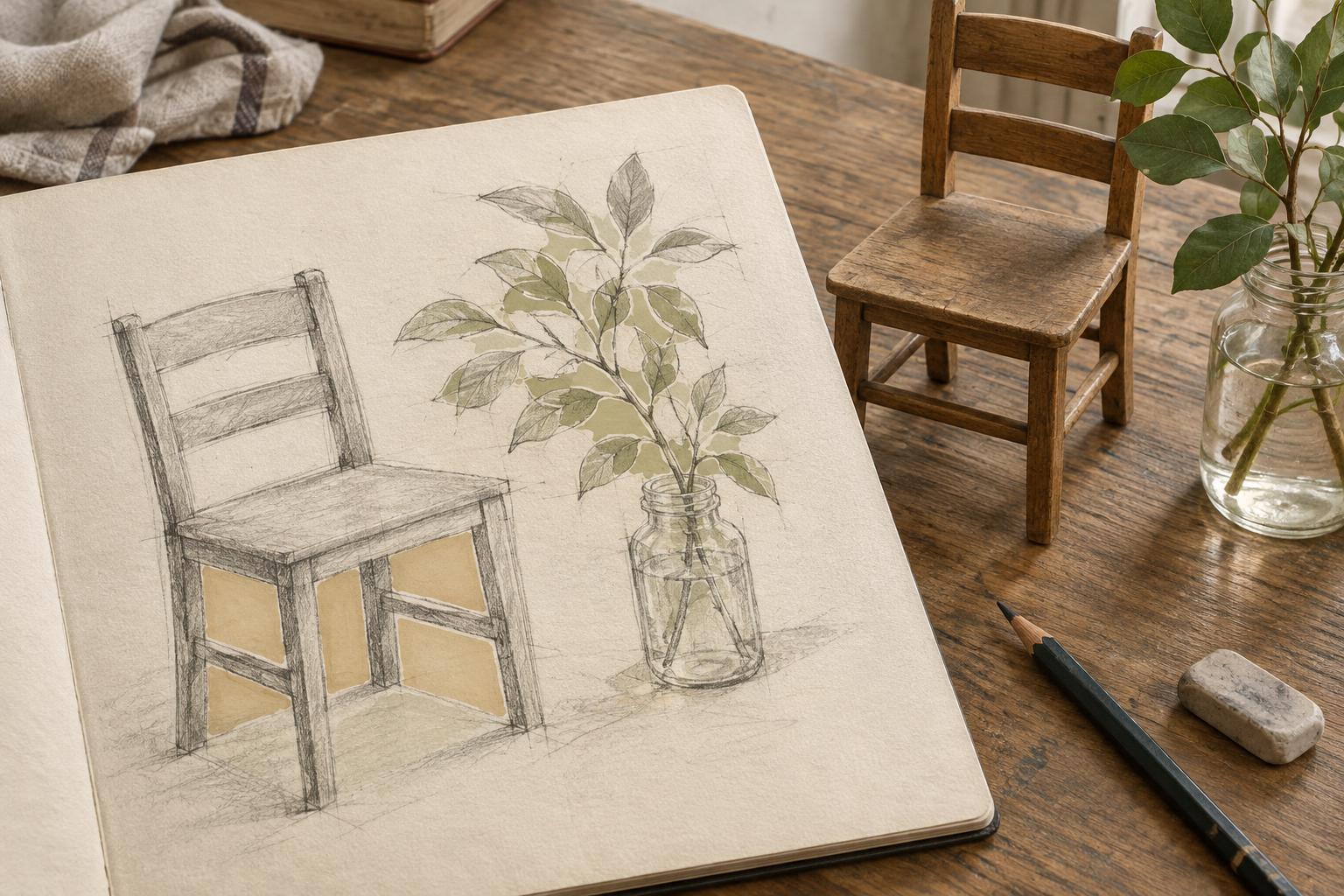
When drawing a chair, it is easy to concentrate on its legs, seat and back. The spaces between those parts may receive much less attention, even though their outlines are defined by the same edges. Those empty areas are negative space. Looking at them gives you another way to judge whether the chair’s parts are in the right places.
Imagine the gap between two chair legs as a shape you could cut from paper. Does it widen toward the floor? Is one side nearly vertical while the other slants? Where does its narrowest point fall? These questions shift your attention away from what the chair is supposed to look like and toward the particular arrangement in front of you. The method works for subjects with open structures, such as plants, bicycles and bent arms, as well as for the space around a single solid object.
Start with the outer silhouette
Before examining small gaps, look at the area between the subject and the edges of your page. If the subject sits too far to one side, the surrounding spaces will make that imbalance apparent. Compare the space above the subject with the space below it. Notice whether the left and right margins feel as wide as they do in your view.
Next, treat the silhouette as the boundary of several simple shapes. The patch of background beside a shoulder might form a wedge; the area above a curved handle might resemble a shallow bowl. Sketch those boundaries lightly. You do not need to name each shape perfectly. The useful question is whether its width, height and direction match what you see. Getting these larger relationships in place early can prevent a drawing from becoming detailed but poorly positioned.
Compare one gap at a time
Choose a negative shape with clear boundaries, such as the opening inside a mug handle. First compare its overall height with its width. Then find its widest and narrowest points, and check the angle of any straight-looking edges. If you are working from a stationary subject, you can hold your pencil at arm’s length to compare angles, keeping your viewing position consistent. You can also briefly squint to make small details less distracting.
Draw the gap lightly, then look at the positive forms that surround it. If the opening is too narrow, for example, the handle may be too close to the mug or too thick. Rather than immediately redrawing every part, identify which boundary seems misplaced. Adjust that edge and check the gap again. This back-and-forth is important: negative space is not a separate object to perfect, but a second view of the relationships you are drawing.
Use negative space during revision
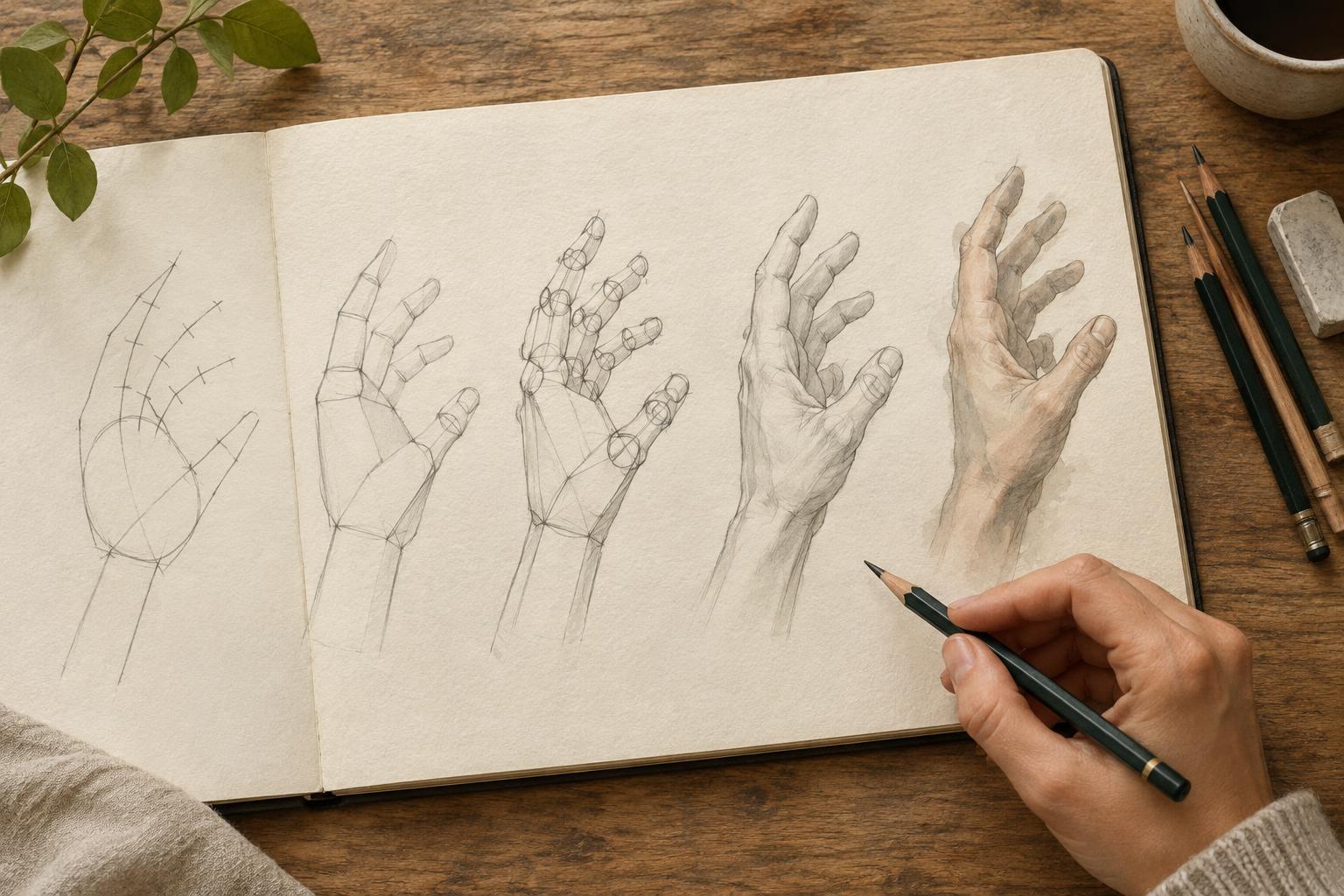
Negative space is especially helpful when a drawing looks plausible but something still feels off. A hand may have recognizable fingers while the openings between them are uneven in ways the reference does not show. A figure’s pose may seem close, yet the triangular space between the arm and torso may be too small. Checking these gaps can point to a specific adjustment instead of prompting you to erase the entire subject.
Work from large spaces to small ones. Compare the broad area beneath an arched object before checking tiny openings within it. Ask whether neighboring gaps change size in the same sequence you observe: narrow, wide, then narrow again, for instance. Avoid making every gap tidy or symmetrical. Irregularity may be part of the subject. If an edge is obscured or soft, estimate its position provisionally and return to it after the clearer relationships are established.
Try a short gap-first exercise
Set up a simple subject with visible openings, such as a chair or a small plant, and keep it in one position. Spend a few minutes drawing only the background shapes around its outer edge and the most obvious gaps inside it. Use light lines and resist the urge to add surface details. Then draw the subject’s contours where those shapes meet. You may find that much of the object is already mapped out.
For a second pass, switch your attention between the object and the spaces every few marks. If one line improves the object but makes an adjacent gap less accurate, pause and compare both sides of that edge. Negative-space checks are most useful when paired with observation of the subject itself. They offer a practical way to test placement and proportion while leaving room for a drawing to remain loose and expressive.