The action that happens between panels
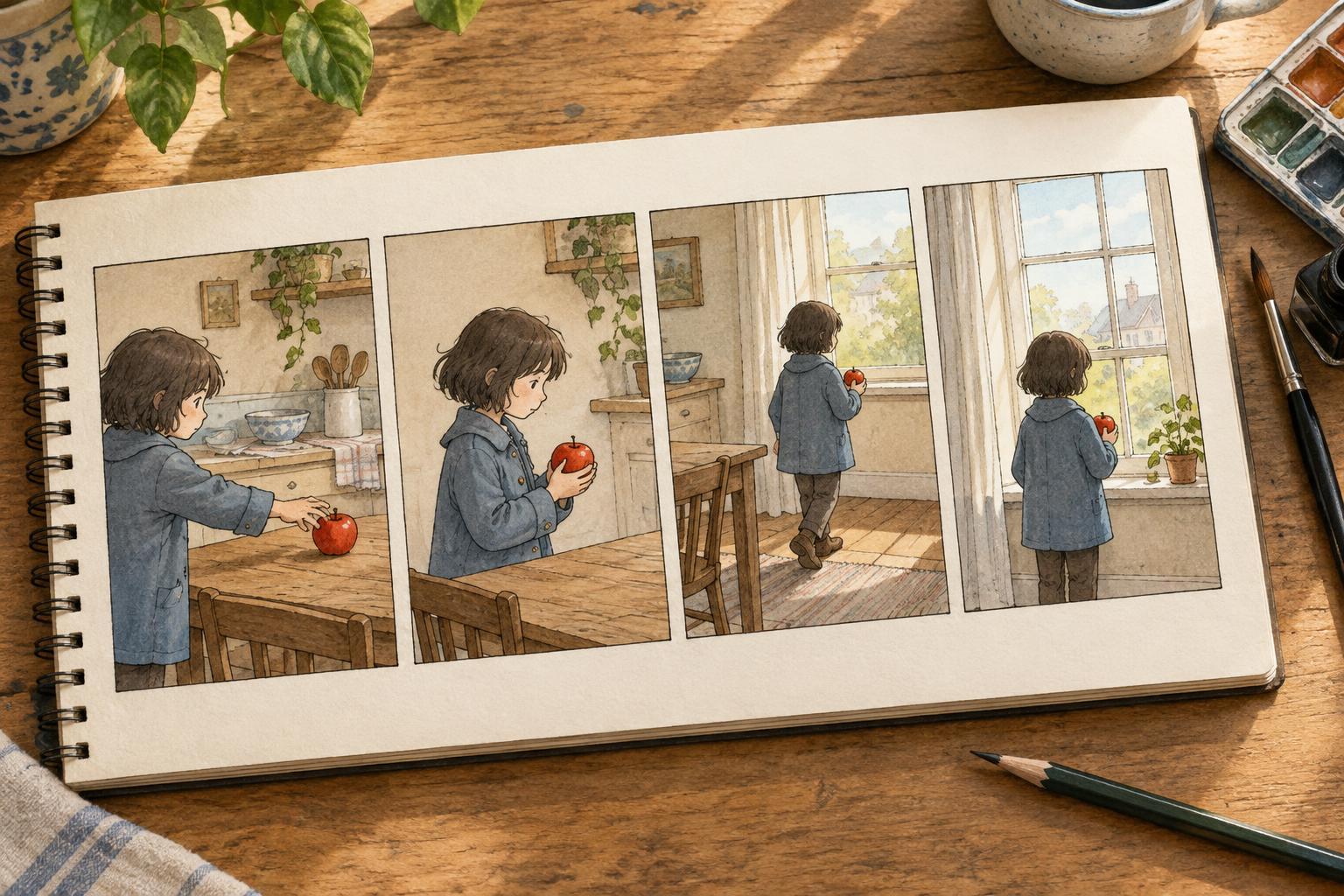
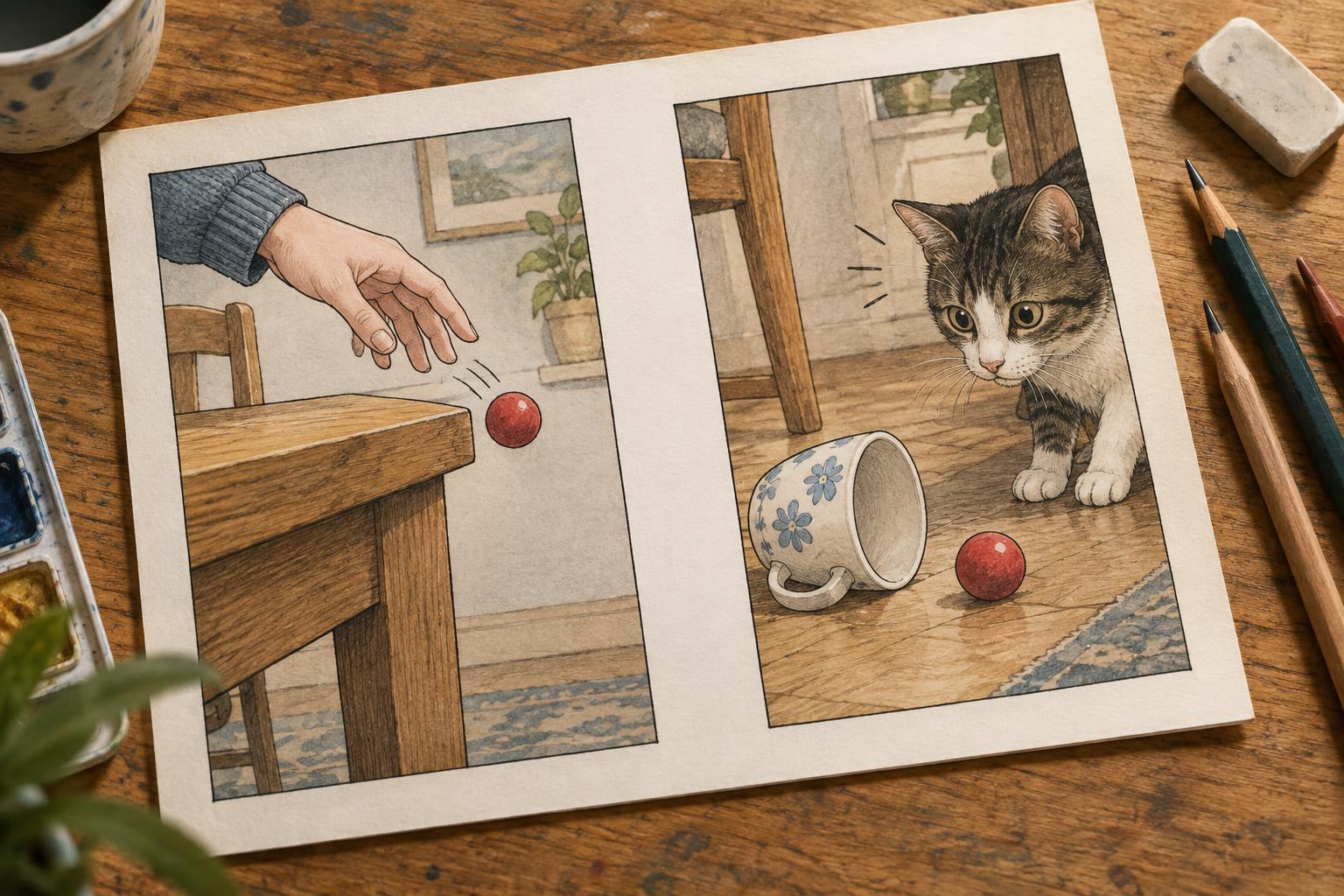
In comics, the gutter is the space separating one panel from the next. A character can raise a cup in one panel and hold a broken handle in the next; the impact and spill may never appear on the page. Readers connect the visible moments and supply the missing action. This is one of the medium’s useful storytelling tools: an artist can make an event feel present without drawing every stage of it.
An omitted action is not automatically a clear action, though. Readers need enough evidence on both sides of the gap to make a plausible connection. The cup’s position, the character’s startled expression, a puddle on the table, or a sound effect might help establish what happened. The aim is not to remove information indiscriminately. It is to choose which information the reader can enjoy putting together.
Choose the moments around the gap
When planning a sequence, try describing the action in a full sentence: “Mara opens the door and finds the room empty.” Then ask which two moments would let a reader understand that sentence without showing every movement. One panel might show Mara reaching for the handle while someone’s coat hangs beside the door. The next might show her inside, facing an empty hook. The missing opening of the door is easy to infer; the missing person becomes the point of the scene.
The amount of change across the gutter affects the reading experience. A small change, such as a hand moving closer to a latch, can slow time and build anticipation. A large change, such as a thrown ball followed by a shattered window, asks the reader to cross a bigger gap and can give the result more force. Neither choice is inherently better. Pick the distance between moments according to what the scene needs the reader to notice: preparation, impact, consequence, or reaction.
Give readers an anchor
A strong inference usually has something stable to hold onto. Keep a recognizable character, object, location, or direction of movement across adjacent panels when the action itself is omitted. If a character runs toward the right edge of one panel, showing the same character beyond an obstacle in the next helps readers connect the journey. A changed pose or a displaced object can then communicate what occurred along the way.
Be careful when several things change at once. If the viewpoint, setting, cast, and time of day all shift across one gutter, readers may interpret the panels as separate scenes rather than one continuous action. That may be exactly what you want for a deliberate jump in time. If you want readers to infer a specific movement, preserve enough visual continuity to make the intended connection likely. A brief caption or a repeated detail can help when the sequence would otherwise be too open to interpretation.
Use omission for surprise, not confusion
The gutter can hide an outcome until a reader reaches the next panel. Imagine a character swinging at a hanging piñata. Instead of drawing the strike, cut from the raised stick to a floor covered in sweets—and the stick lodged in a ceiling tile. The gap lets the reader reconstruct the mishap, while the second panel delivers the surprise. For a quieter scene, cut from a hand hovering over a letter to that letter folded into a pocket. The reader can infer the decision without a panel devoted to picking it up.
A useful check is to ask what question the first panel creates and whether the next panel answers it. “Will the stick hit?” is answered by the damaged ceiling. “What did the character decide?” is answered by the letter’s new location. If the second panel introduces unrelated information instead, the omission may feel like a missing drawing rather than an intentional beat. You can leave a character’s motives uncertain while still making the physical sequence understandable.
Try a two-panel exercise
Choose a simple action with a visible result: dropping keys, knocking over a plant, or stepping into a puddle. First, draw it in three panels: setup, action, and consequence. Then remove the middle panel. Look at the two remaining images without referring to your notes. Can you tell what happened, where it happened, and who caused it? If not, change one concrete detail—a hand position, a footprint, the placement of an object—before adding explanatory text.
Next, make two versions of the same pair of panels. In one, show the instant just before the action; in the other, show an earlier setup. Compare how long each version seems to pause before the result. Ask someone unfamiliar with the scene to describe what they think occurred between panels. Their account does not need to match every detail you imagined, but it should capture the action that matters to the story. That small test can reveal whether the gutter invites inference or simply leaves a gap.